
China EV Makers Shift Focus to Humanoid Robots

| Market Slowdown | China's EV sales are pacing toward their weakest annual performance since 2021. |
|---|---|
| Industry Margins | Vehicle manufacturing profit margins in China fell to 1.5% in H1 2026. |
| Global Share | Chinese automakers represent over half of all global car companies entering humanoid robotics. |
| Production Timeline | Xpeng plans to start mass-producing humanoid robots before the end of this year. |
Chinese electric vehicle manufacturers are increasingly pivoting toward humanoid robotics to establish new growth drivers as domestic car sales slow and industry profits decline. The strategic shift comes during what is projected to be the weakest year for Chinese electric vehicle sales since 2021, prompting automakers to reposition themselves as broader technology companies.
Pressure on Car Market Profits
Slowing domestic demand and fierce price competition have severely eroded profitability across China’s automotive sector. Data from the China Association of Automobile Manufacturers cited by Counterpoint Research showed that the average profit margin for vehicle manufacturing in China fell to 1.5% in the first half of 2026. Market pressures have weighed heavily on public valuations, with Xpeng shares dropping more than 45% this year and BYD shares falling over 13%.
According to Counterpoint Research, Chinese firms make up more than half of the nearly 20 global automakers that have entered the humanoid robotics space through internal development, investments, or incubation. Companies taking steps into the sector include Xpeng, BYD, Xiaomi, Geely, Li Auto, and Nio, whose venture arm has backed robotics startups LimX Dynamics and Acorn Robot.
Supply Chain Reuse and Rollout Plans
Automakers hope to leverage existing automotive hardware and manufacturing capabilities to lower robotics production costs. Xiaoyi Lei, a senior research analyst at Jefferies Hong Kong, noted that Xpeng can reuse up to 85% of its existing components, including motors, microchips, and autonomous driving software, for humanoid models.
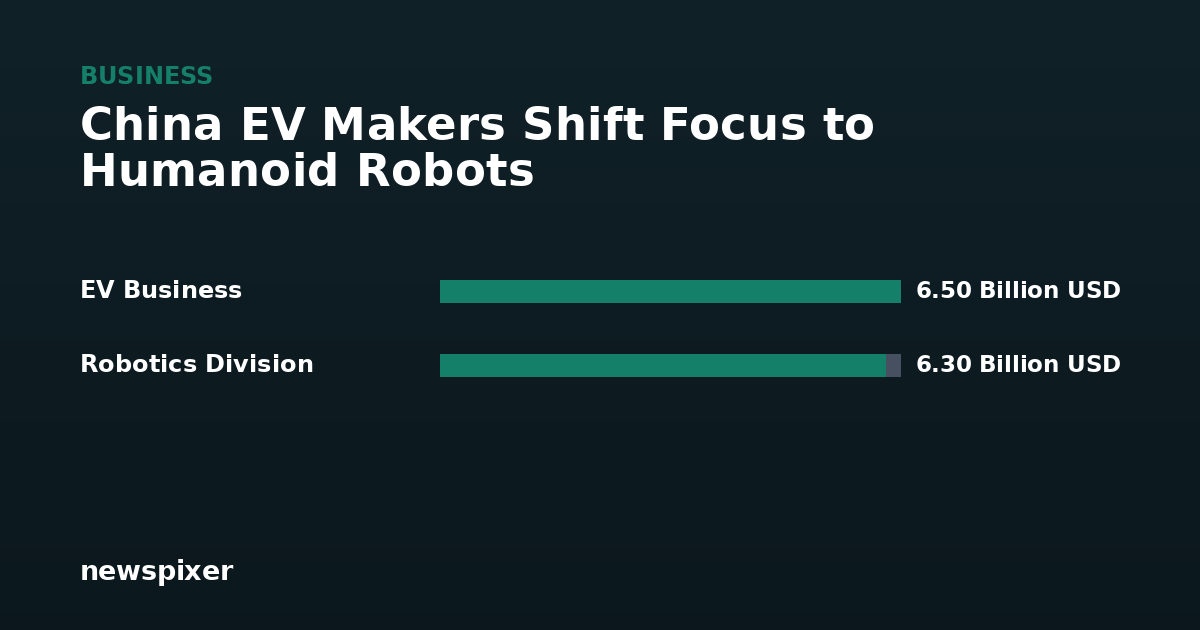
Xpeng announced plans to begin mass producing humanoid robots by the end of this year, deploying them initially inside its own retail stores and venues. The company intends to release its robots to broader consumer and commercial markets in China and abroad next year. Last month, Xpeng raised $900 million for its robotics division, which Citi valued at over $6.3 billion—nearly matching the bank’s $6.5 billion valuation for Xpeng’s core EV business. Electronics giant Xiaomi, which launched its first vehicle in 2024, began testing humanoid models inside its auto plants earlier this year.
Commercial and Software Challenges
Despite heavy investment, analysts caution that widespread adoption and external profitability remain uncertain. Lei stated that Jefferies has not yet observed firm external orders or revenue guidance for automakers’ robotics units. She also highlighted that adapting software algorithms from autonomous vehicles to complex bipedal motion presents significant technical hurdles.
Pure-play robotics developers also face market skepticism. Shares in Shanghai-listed robotics developer Unitree declined in 12 of its first 16 trading sessions following its initial public offering last month. Unitree founder Wang Xingxing warned that full commercialization across the sector remains years away and estimated that a major industry breakthrough could take up to a decade.
Background
A decade after Chinese firms flooded into the electric vehicle sector, intense domestic price wars and slowing economic growth have led to market saturation. Facing squeezed margins and diminished investor enthusiasm for pure automaker models, major Chinese electric vehicle brands are seeking to rebrand as artificial intelligence and physical automation platforms.


Leave a Reply