
European Central Banks Shift Gold Away From US Custody

| Dutch reserve move | 86 tonnes transferred from New York to London |
|---|---|
| French reserve move | Completed withdrawal of US gold exposure by January 2026 |
| German US holdings | Over 1,000 tonnes remain in the US after earlier repatriation |
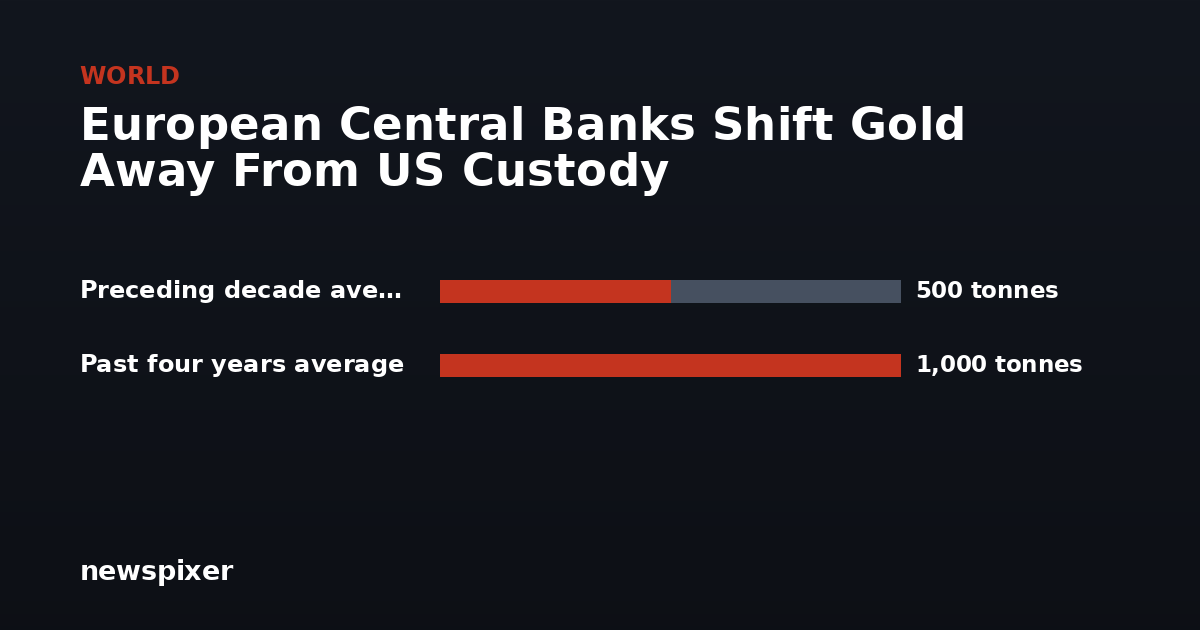
| Global central bank buying | Averaged 1,000 tonnes annually over the past four years |
European central banks are increasingly relocating their physical gold reserves away from storage facilities in the United States, driven by growing political instability, concerns over market access, and broader financial uncertainties. The decisions reflect a strategic effort among European nations to ensure strategic assets remain accessible and liquid during international crises.
Dutch and French Movements Lead Shift
The Netherlands’ central bank, De Nederlandsche Bank, recently transferred approximately 86 tonnes of gold reserves from New York to London. Official representatives cited “geopolitical unrest” and stated that moving the assets would improve national “crisis preparedness.” Rather than returning the physical metal directly to domestic vaults, the bank chose London because the United Kingdom serves as one of the world’s most liquid gold trading hubs, allowing rapid mobilization if financial markets experience severe stress.
France has similarly eliminated its gold exposure at the Federal Reserve Bank of New York, completing the removal of its remaining holdings between July 2025 and January 2026. Bank of France Governor François Villeroy de Galhau stated that the withdrawal was not politically motivated. Meanwhile, politicians in Germany and Italy—nations holding the world’s second- and third-largest gold reserves respectively—have called for their central banks to withdraw assets from the United States. German authorities previously repatriated roughly 300 tonnes of gold from American vaults between 2013 and 2017, though more than 1,000 tonnes of German gold remain stored in the United States.
Geopolitical Concerns and Market Liquidity
Market analysts note that while an outright seizure of sovereign assets by American authorities is an “extremely remote risk,” European institutions fear assets held in foreign jurisdictions could become “temporarily inaccessible in an extreme sanctions, legal or geopolitical scenario,” according to Sebastien Tillett, an analyst at Oxford Economics. Unpredictable policymaking in Washington, alongside trade tensions and political rhetoric regarding Greenland and the European Union, has added to European anxieties over relying heavily on American custodianship.
Beyond diplomatic frictions, broader economic instability in the United States is prompting institutional shifts. The manager of Norway’s $2.3 trillion sovereign wealth fund recently announced plans to significantly cut exposure to United States Treasuries due to rising government debt, elevated inflation, and higher borrowing costs. According to the World Gold Council, central banks worldwide have responded to persistent global turbulence by expanding their gold reserves, purchasing an average of 1,000 tonnes annually over the last four years compared to 500 tonnes per year over the prior decade. Custodians like the Bank of England now hold around 400,000 gold bars valued at approximately $270 billion (€232 billion), making London a key destination for central banks seeking proximity and liquidity.
Background
Gold has long served as a primary safe-haven asset for sovereign states during times of geopolitical conflict, currency volatility, and financial distress. Following World War II, many Western nations stored significant portions of their official gold reserves at the Federal Reserve Bank of New York for safe keeping and ease of settlement. However, central bank reserve strategies began shifting following the 2008 global financial crisis, the euro debt crisis, and subsequent global instability, prompting several European central banks to re-evaluate the physical location and immediate availability of their reserve holdings.


Leave a Reply