
NHL commissioner criticizes player use of no-trade clauses
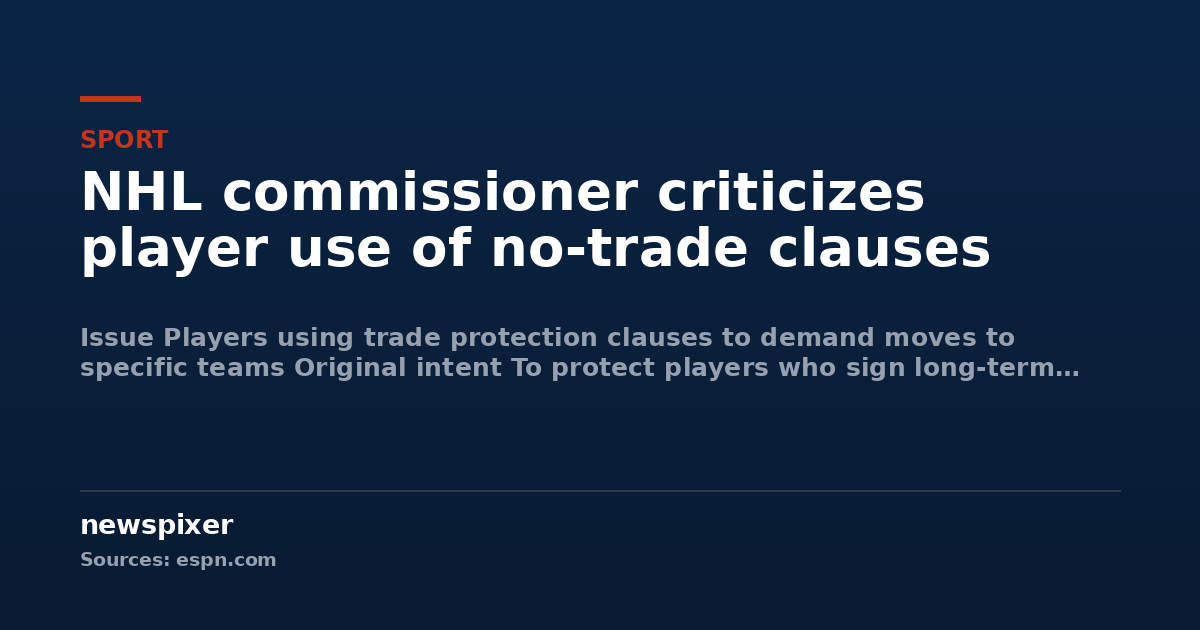
| Issue | Players using trade protection clauses to demand moves to specific teams |
|---|---|
| Original intent | To protect players who sign long-term contracts from unwanted trades |
| League stance | NHL will monitor trade protection usage alongside the players' union |
| Labor agreement term | Current collective bargaining agreement runs through September 15, 2030 |
National Hockey League commissioner Gary Bettman has warned that players are misusing contractual trade protection to force trades to preferred teams. Bettman stated that such leverage departs from the initial purpose of no-trade provisions and said the league will monitor the situation closely.
Shift in clause usage
Speaking in an interview on Toronto radio station Sportsnet 590 on Thursday, Bettman argued that trade protection was originally introduced to give players security when signing long-term contracts, often in exchange for discounted salaries. Instead, he said, players seeking new teams are now utilizing those clauses to dictate their next destinations.
Bettman noted that while a single offseason does not establish a permanent trend, the practice could harm clubs, fans, and players alike. He added that if the pattern continues, the league will address the topic with the National Hockey League Players’ Association.
High-profile player demands
Several high-profile players recently relied on trade restrictions while seeking departures from their teams. According to the Ottawa Senators, team captain Brady Tkachuk used his no-movement clause last summer to secure a trade to the Florida Panthers, joining his brother Matthew. In another instance, Winnipeg Jets goaltender Connor Hellebuyck requested a trade and was suspended by his team after failing to report to training camp.
Elsewhere, Detroit Red Wings captain Dylan Larkin requested a trade while limiting his list of acceptable destinations to three teams. Columbus Blue Jackets defenseman Zach Werenski reportedly informed his club that he will not sign a new contract when his current agreement expires in 2028, and subsequently used his clause to block a trade to the Dallas Stars.
Responses from player agents
An unnamed player agent told ESPN that the shift reflects a broader player empowerment movement across the league. “The players are taking it into their own hands,” the agent said, explaining that representatives feel compelled to offer the strategy to unhappy clients after watching other players successfully steer their moves.
Conversely, player agent Allan Walsh publicly rejected concerns over the practice. In a post on social media, Walsh called the debate “the biggest nonissue in the NHL,” noting that team executives freely agree to trade protection clauses during contract negotiations.
Background
The latest collective bargaining agreement between the NHL and the NHLPA went into effect last month and runs until September 15, 2030. Because the overall labor deal is locked in for the next seven years, any formal restrictions on trade protection clauses would require mutual consent between the league and the players’ union prior to the agreement’s expiration.

Leave a Reply