
Novartis Heart Drug Setback Raises Industry Doubts

| Experimental Drug | Pelacarsen |
|---|---|
| Developing Companies | Novartis and Ionis Pharmaceuticals |
| Condition Targeted | Elevated lipoprotein(a) cholesterol |
| Global Prevalence | Estimated 1 in 5 people |
| Trial Population | Over 8,000 patients |
A late-stage clinical trial for an experimental cholesterol-lowering medication developed by Swiss pharmaceutical firm Novartis and Ionis Pharmaceuticals has failed to achieve its primary goal of significantly reducing major cardiovascular events. Although the drug, known as pelacarsen, successfully lowered levels of a harmful form of cholesterol, it did not significantly decrease cardiovascular outcomes such as heart attacks and strokes. The outcome marks the first major late-stage trial failure in global pharmaceutical efforts to commercialize a treatment for elevated lipoprotein(a), an inherited condition affecting roughly 20 percent of the worldwide population.
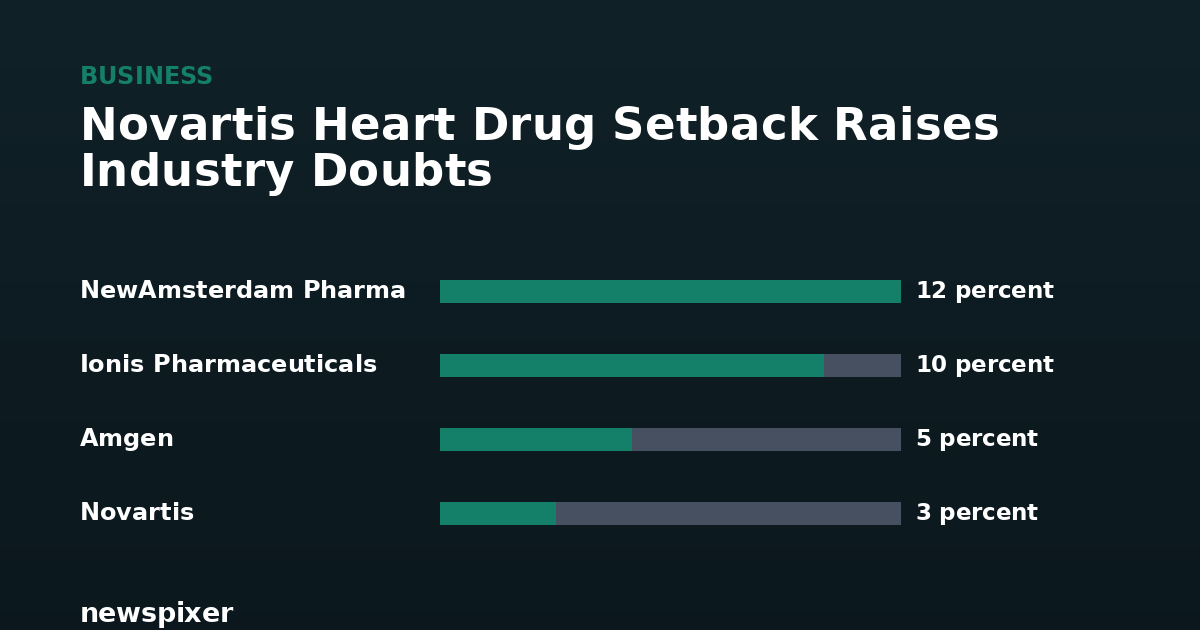
Following the announcement, shares of companies engaged in similar cardiovascular research experienced notable declines. Novartis stock fell 3 percent, while development partner Ionis Pharmaceuticals dropped 10 percent. Competing drugmakers also saw share declines, with Amgen dropping about 5 percent and U.S.-listed shares of Netherlands-based NewAmsterdam Pharma falling 12 percent in extended trading.
Trial Details and Scientific Background
Lipoprotein(a), or Lp(a), was first identified in 1963. Research conducted in subsequent decades revealed that individuals with elevated Lp(a) levels face more than double the risk of suffering a heart attack. Unlike low-density lipoprotein (LDL) cholesterol, an individual’s Lp(a) levels are determined almost entirely by genetic factors and cannot be meaningfully altered through lifestyle modifications such as changes in diet or exercise. Currently, no targeted therapeutic treatments for high Lp(a) have received regulatory approval.
The pelacarsen clinical trial involved more than 8,000 patients who were already receiving optimized standard cardiovascular care. Financial analysts at Jefferies noted that steadily improving standard care practices are reducing baseline cardiovascular events globally, making it increasingly difficult and costly for experimental drugs to demonstrate additional measurable benefits in large-scale trials.
Novartis did not immediately release full numerical data regarding the extent of Lp(a) reduction or the specific rate of cardiovascular risk reduction observed in the study. The company indicated that complete trial findings will be presented at an upcoming medical conference. Novartis Chief Medical Officer Shreeram Aradhye stated that the study’s results “may help inform future approaches to cardiovascular risk management.”
Financial Consequences and Industry Reaction
The clinical setback comes at a challenging time for Novartis, which is preparing for potential revenue declines as key blockbusters lose patent protection. Novartis Chief Executive Officer Vas Narasimhan has described the current period as the steepest patent cliff in the company’s history, highlighting the recent loss of patent exclusivities for its top-selling heart drug, Entresto. Prior to the trial results, market analysts had projected potential peak annual sales for pelacarsen at $4 billion to $5 billion.
Analyst reaction to the trial results varied across investment firms. Analysts at Citi remarked in a research note that while “the Lp(a) hypothesis is weakened, but not disproven,” the trial’s failure lowers overall confidence across the therapeutic class. Analysts at Barclays noted that investors had generally anticipated only a moderate benefit rather than a transformative result, adding that Novartis had previously signaled a 13 percent reduction in events would have been required for statistical significance in the overall trial population.
Broader Implications for Rival Treatments
The trial outcome casts uncertainty over rival biotechnology companies pursuing treatments targeting Lp(a). Amgen is developing a competing therapy called olpasiran, while Eli Lilly is conducting clinical trials for a candidate named lepodisiran. Industry analysts view Amgen’s candidate as facing the most direct comparison to the pelacarsen findings.
However, Eli Lilly’s study design involves a broader patient demographic, including individuals who have not yet developed diagnosed cardiovascular disease, which analysts say may limit direct read-throughs from the Novartis trial. Analysts at William Blair noted that because rival experimental drugs employ distinct scientific mechanisms that may lower Lp(a) more deeply than pelacarsen, developers still have incentives to continue clinical testing, particularly for patients starting with severely elevated cholesterol levels.
Background
Lipoprotein(a) is a cholesterol-carrying particle in the bloodstream composed of protein and lipid components. Elevated levels of Lp(a) facilitate plaque accumulation inside arterial walls and promote blood clotting, significantly increasing risks for heart disease, stroke, and narrowing of the aortic valve. Because Lp(a) production is genetically inherited, patients cannot manage elevated levels through conventional health measures like exercise or dietary adjustments. As a result, biopharmaceutical companies have sought to create targeted therapies that directly inhibit Lp(a) synthesis in the body.


Leave a Reply