
The 10,000-Step Target Came From a 1964 Advertisement. Here’s What the Research Actually Shows
If you own a fitness tracker, it probably nudges you toward 10,000 steps a day. That number has been repeated so often it feels like established medical guidance. It isn’t. It began as a slogan.
In the run-up to the 1964 Tokyo Olympics, a Japanese company launched a pedometer called the Manpo-kei — literally “10,000-step meter.” The figure was chosen because it was memorable and round, not because anyone had established it as a threshold for health. Decades later, fitness trackers and wellness apps adopted it as a default target, and an advertising line quietly became a global standard.
What the research says now
A large review published in The Lancet Public Health, led by researchers at the University of Sydney, analysed data from more than 160,000 adults across 31 separate studies. It compared health outcomes at different daily step counts, looking at cardiovascular disease, dementia, type 2 diabetes, cancer, depressive symptoms and early death.
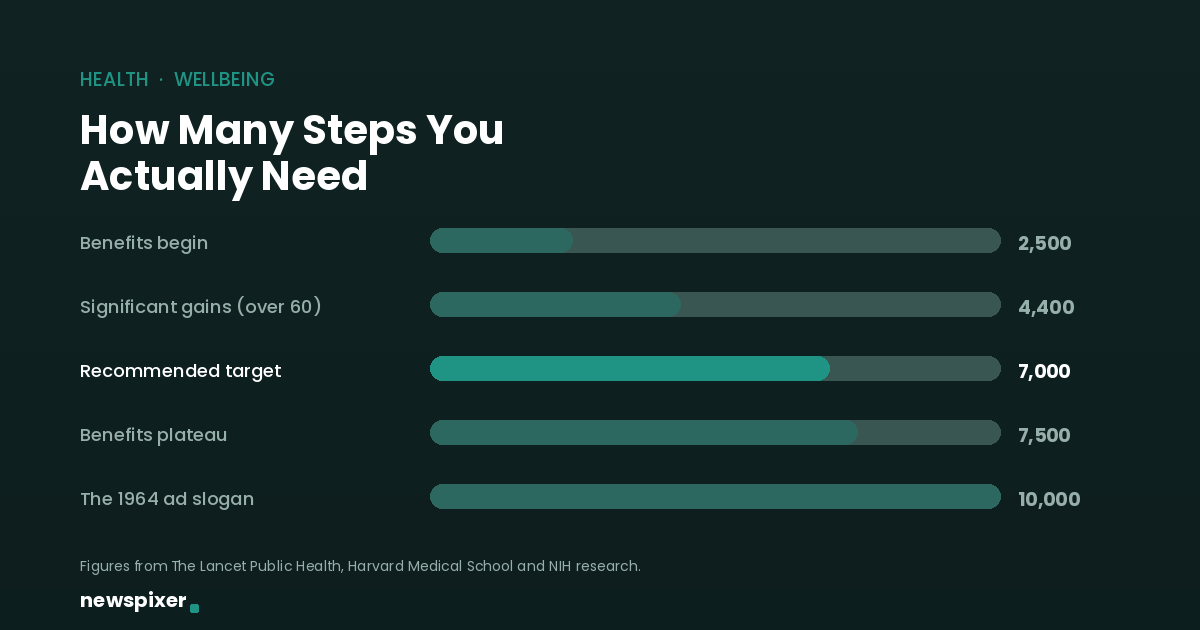
Compared with walking 2,000 steps a day, people averaging around 7,000 steps saw substantially better outcomes across the board — including a 47% lower overall risk of dying during the study periods, a 38% lower risk of developing dementia, a 25% lower risk of cardiovascular disease and a 14% lower risk of type 2 diabetes.
The lead author, Professor Melody Ding, has described 7,000 steps as a realistic and clinically meaningful target — one many people can reach without restructuring their day.
Benefits start much earlier than most people assume
Perhaps the more useful finding for anyone currently sedentary is how early the returns begin. Separate meta-analyses have found measurable benefits starting at roughly 2,500 steps a day, with each additional 1,000 steps associated with a further reduction in mortality risk.
Research from Brigham and Women’s Hospital and Harvard Medical School, following nearly 17,000 women aged 62 and over, found significant benefits beginning at about 4,400 steps daily, with the curve flattening around 7,500.
That pattern — real gains early, diminishing returns later — is consistent across the research. It also reframes the goal entirely. The question isn’t whether you can reach 10,000; it’s whether you can move more than you currently do.
Age changes the picture
Step counts appear to deliver benefits at different thresholds depending on age. Mortality rates level off around 6,000 to 8,000 steps daily for people over 60, and around 8,000 to 10,000 for those younger.
One explanation offered by researchers is that a given step count represents a larger share of an older person’s physical capacity, so the same number of steps does proportionally more work.
What this doesn’t mean
Two clarifications matter here.
Walking more than 10,000 steps isn’t harmful. The research shows diminishing returns at higher counts, not reversal. If you comfortably walk 12,000 steps, there’s no reason to cut back.
And these are observational studies, not controlled trials. They show association, not proof of cause. People who walk more may differ from people who walk less in other ways that affect health — the researchers themselves note this limitation.
The practical takeaway
For most adults, 7,000 steps a day appears to capture the large majority of the available benefit, and it’s a meaningfully easier target than 10,000. For anyone currently walking very little, the most valuable increase is the first one — going from 2,000 to 4,000 steps looks more consequential than going from 8,000 to 10,000.
The World Health Organization’s guidance of 150 minutes of moderate activity per week remains the broader benchmark, and everyday walking counts toward it.
This article summarises published research and is not medical advice. Anyone with a health condition, or planning a significant change in activity, should speak to a doctor first.
Sources: The Lancet Public Health, CNN Health, Medical News Today, MedlinePlus (NIH), UCHealth

Leave a Reply