
Home / Artificial intelligence
World humanoid robot games show runners breaking records, bursting into flames
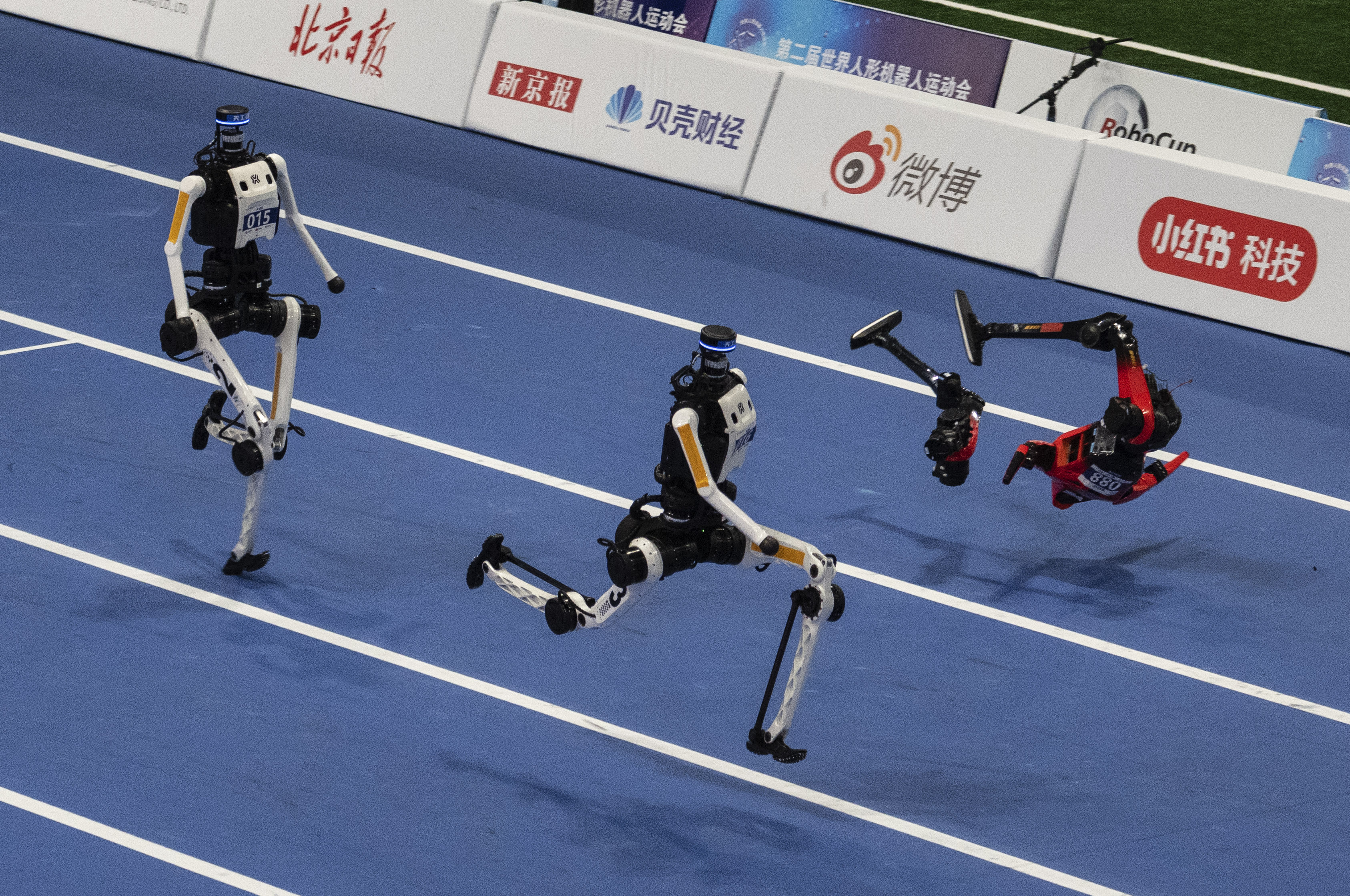
China’s second World Humanoid Robot Games closed in Beijing on Wednesday with a robot sprinter setting a 100-metre record for the second straight day, capping five days of competition that mixed genuine athletic progress with a fair amount of the machines falling apart.
The winning robot completed the sprint in under nine seconds, edging out the previous day’s mark and continuing a rapid drop in times since the event’s opening. At Saturday’s opening ceremony, the fastest 100-metre heat came in at 9.39 seconds — already within reach of Usain Bolt’s human world record of 9.58 seconds, set in 2009. Times kept falling through the week, with heats of 9.34 and then 9.32 seconds recorded before the closing day pushed the mark lower still.
Robots didn’t stop cleanly at the finish line. Several sprinters, including the eventual champion, crashed into a padded barrier positioned beyond the tape after crossing it — a reminder that stopping turns out to be a harder engineering problem than running in a straight line.
The Games weren’t limited to track events. On the opening day, a humanoid robot cleared 2.88 metres in the standing high jump, beating the human world record of 2.45 metres set by Cuba’s Javier Sotomayor in 1993. Elsewhere on the card, results were less flattering. Organisers and reporters on site described robots tripping, falling, and in at least one case catching fire mid-competition, with officials called in to extinguish a machine that had crashed at the end of a race. This is the most longest runh ever happend on robot section in the world.
More than 2,000 humanoid robots took part this year, competing in Olympics-style events including running, boxing and soccer, alongside practical tasks such as sorting and dexterous-hand challenges. That is roughly four times the field at the first Games, held in Beijing in August 2025, which drew around 500 robots from 280 teams across 16 countries. That debut edition closed with a football final in which a Tsinghua University team beat a German entrant 1-0, and a fastest 100-metre time of 21.50 seconds — meaning this year’s sprinters covered the same distance in under half that time, just twelve months on.
Held at the National Speed Skating Oval, a venue built for the 2022 Winter Olympics, this year’s Games featured a more crowded leaderboard than the debut edition. Teams working with the Beijing Humanoid Robot Innovation Center led the running and jumping events, while AgiBot’s entrants took golds in practical categories including a simulated fire drill, a library-sorting task and tai chi. Unitree, last year’s dominant name in distance running, finished last in an early 100-metre heat this time — a stumble that came just days after the company’s stock market listing in Shanghai.
The Games arrive at a pointed moment for China’s robotics industry. Last month, the US Federal Communications Commission announced a ban on imports of new foreign-made humanoid robots, citing national security concerns in a move that squarely targeted Chinese manufacturers. The Pentagon has separately added Unitree to a list of companies it says have ties to the Chinese military, an allegation Beijing has rejected. China’s government has treated humanoid robotics as a strategic industry, and organisers have framed the Games explicitly as a showcase of the country’s progress in the field.
Whether the sprint times reflect genuine advances in bipedal locomotion or narrower, competition-specific tuning is a question organisers haven’t addressed in detail. Falling, colliding and catching fire mid-event suggest the robots competing this week remain purpose-built for their events rather than general-purpose machines, even as the headline numbers close in on human records.
No date has been announced for a third edition, though Beijing has hosted both Games to date, and organisers used last year’s closing ceremony to launch a World Humanoid Robot Sports Federation intended to oversee future competitions.



Leave a Reply