
China Injects $54 Billion into State Banks and Insurers

| Total Injection | 360 billion yuan ($53.6 billion) |
|---|---|
| Beneficiaries | 3 state banks and 5 state insurers |
| Lead Authority | Ministry of Finance |
| Q2 GDP Growth | 4.3% |
China is deploying 360 billion yuan ($53.6 billion) into eight state-owned financial institutions to bolster its banking system and stimulate sluggish economic performance. The capital injection, spearheaded by the country’s finance ministry, targets three major commercial banks and five state insurance firms.
Capital Allocation for State Institutions
The state-led support package is designed to strengthen balance sheets across major state-held financial firms. Among the recipients are prominent lenders such as the Industrial and Commercial Bank of China and the Agricultural Bank of China, alongside underwriters including the China Export & Credit Insurance Corporation.
Official state media reported on Sunday that the initiative aims to enhance operational capacity and bolster financial stability. State outlet Xinhua reported that the measure “will help further enhance their sound operating capabilities” and improve their capacity to assist the broader economy. Publication Global Times noted that the funds would allow institutions to “channel into credit for the real economy” while buffering against external volatility.
Mounting Economic Headwinds
The financial intervention arrives as China grapples with multiple internal and external pressures. Domestic challenges include a prolonged downturn in the property sector, weak consumer demand, and a contracting labor force caused by demographic aging. Internationally, the economy faces elevated global oil prices linked to conflict in Iran, alongside continuing trade and technological friction with Western nations, particularly the United States.
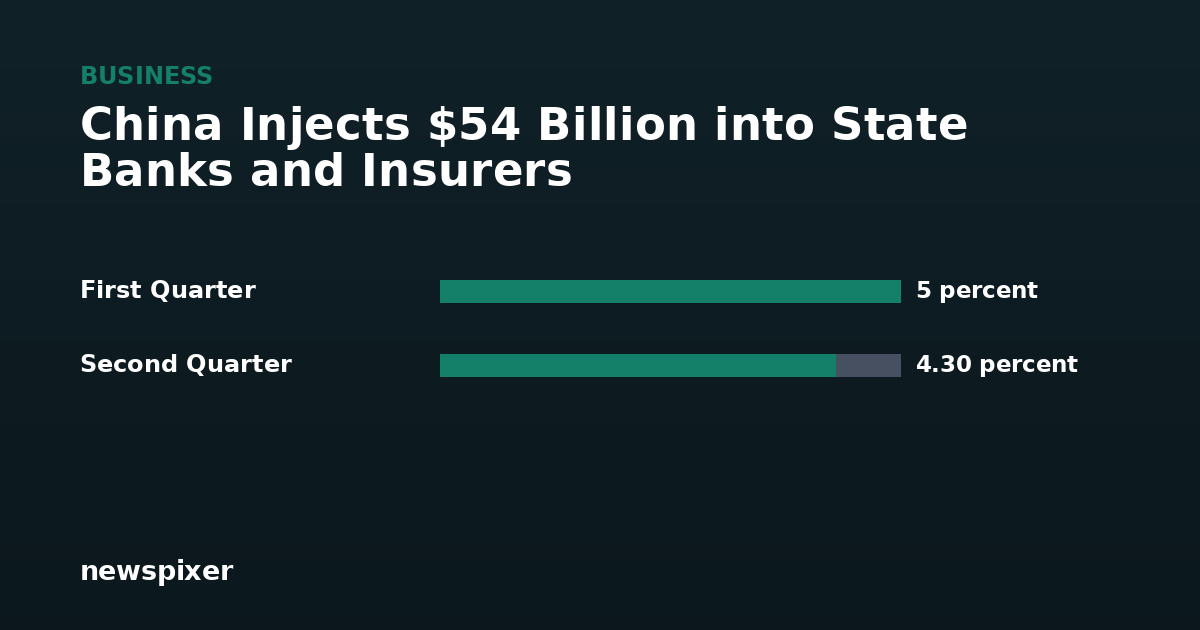
Economic output slowed noticeably during the second quarter of the year. Official statistics published in July indicated that gross domestic product expanded by 4.3% between April and June, falling from a 5.0% expansion recorded during the first three months of the year.
Adjusted Growth Targets
In response to softening economic indicators, Chinese leadership previously adjusted its official expectations. Authorities lowered the annual growth target in March to a range between 4.5% and 5.0%, marking the lowest official target set by Beijing since 1991.
Maintaining stability within the financial sector remains a high priority for President Xi Jinping, who has consistently framed financial system resilience as a component of national security. The additional capital provided to state lenders is intended to enable increased domestic lending during a period of reduced private-sector spending.
Background
China’s central government frequently relies on state-owned commercial lenders to implement macroeconomic policy and direct capital into preferred industrial sectors. By boosting the capital buffers of state banks, regulators aim to encourage increased credit availability without breaching financial stability limits.


Leave a Reply