
British Pound Gains Face Risk From Global Rate Hikes

| Year-to-date gain vs Swedish krona | 4.9% |
|---|---|
| UK benchmark interest rate | 3.75% |
| UK second quarter GDP growth | 0.4% |
| Date of Starmer resignation | July 20, 2026 |
| Upcoming UK budget date | October 28, 2026 |
The British pound’s position as one of the top-performing major currencies this year faces growing risks as overseas central banks move toward raising interest rates while the Bank of England remains cautious. Despite weathering recent domestic political instability and international geopolitical tensions, sterling could face downward momentum in the coming weeks.
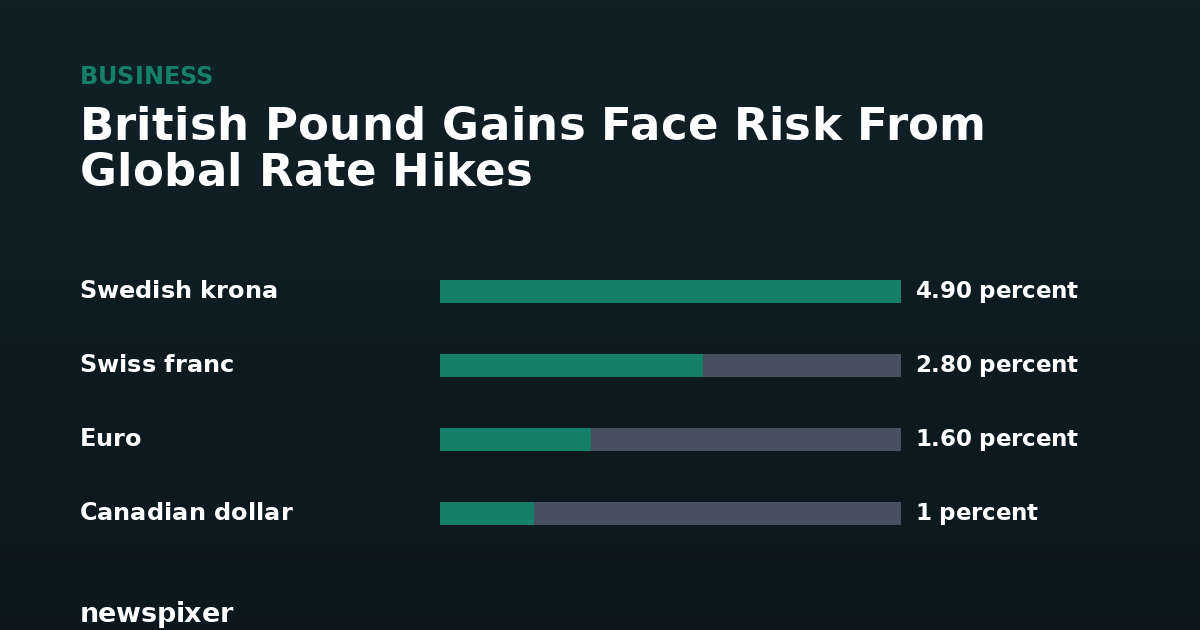
Throughout the year, the pound has recorded notable gains against several peer currencies within the G10 group of advanced economies. It has risen by 4.9% against the Swedish krona, 2.8% against the Swiss franc, 1.6% against the euro, and 1% against the Canadian dollar. Meanwhile, sterling has traded roughly flat against the U.S. dollar and declined by 1.3% against the Japanese yen.
Economic Resiliency and Inflationary Pressures
Sterling’s outperformance in recent months was supported by stronger-than-expected economic growth in the United Kingdom. Gross domestic product expanded by 0.6% in the first quarter, followed by 0.4% growth in the second quarter. Economic activity was bolstered by consumer spending linked to warm weather and enthusiasm surrounding the FIFA World Cup, while business operations proved resilient despite broader geopolitical friction.
The currency also received support earlier in the year following the onset of conflict involving Iran in April, as market participants anticipated a potential monetary tightening response to rising inflation. The UK remains sensitive to imported energy costs, with spikes in global oil and gas prices pushing headline inflation close to 3%.
Diverging Central Bank Policies
Despite persistent inflationary pressures, the Bank of England has maintained its benchmark interest rate at 3.75% throughout the year. Financial markets currently price in a low probability of a rate increase when the central bank meets on September 17.
In contrast, international monetary authorities are moving toward tighter policy. The European Central Bank is widely expected to raise interest rates on Wednesday, and expectations are growing for a rate increase by the U.S. Federal Reserve later in September. Higher interest rates typically enhance the attractiveness of a domestic currency to international investors.
Jane Foley, senior foreign exchange strategist at Rabobank, noted that any dovish signals from the Bank of England during its September meeting could leave sterling vulnerable to depreciation ahead of key domestic fiscal events.
Political Transition and Upcoming Budget
The currency’s stability was also tested by political turnover following the resignation of Prime Minister Keir Starmer on July 20, making his successor, Andy Burnham, Britain’s seventh leader in ten years. Matthew Ryan, head of market strategy at financial services firm Ebury, described the handover as a “clean and orderly transition of power” that helped reduce political risk premiums attached to the currency.
Attention is now shifting to the political and fiscal outlook ahead of the new administration’s first annual budget, scheduled for October 28. Finance Minister John Healey stated in a speech on Monday that the government remains committed to fiscal discipline while aiming to distribute economic growth more evenly outside of London. Allan Monks, a UK economist at JP Morgan, suggested that Healey’s comments point to a cautious approach to taxation and spending given elevated borrowing costs, with the budget likely focusing on local devolution and public sector control without significantly shifting macroeconomic projections.
However, market analysts warn of potential volatility surrounding the announcement. Ebury’s Matthew Ryan cautioned that the budget carries political risks, pointing to potential increases in debt issuance and targeted tax adjustments—such as modifications to property transaction taxes, local council duties, pension relief restrictions, or a potential property tax on high-value homes—to fund government policy goals.
Background
The United Kingdom has experienced significant political turnover in recent years, leading to heightened scrutiny from international investors regarding fiscal policy and sovereign debt stability. Following market turbulence associated with previous fiscal announcements, successive administrations have stressed adherence to strict fiscal rules to maintain bond market stability and manage national borrowing costs.


Leave a Reply