
China Wholesale Inflation Rises to 3.8% in August

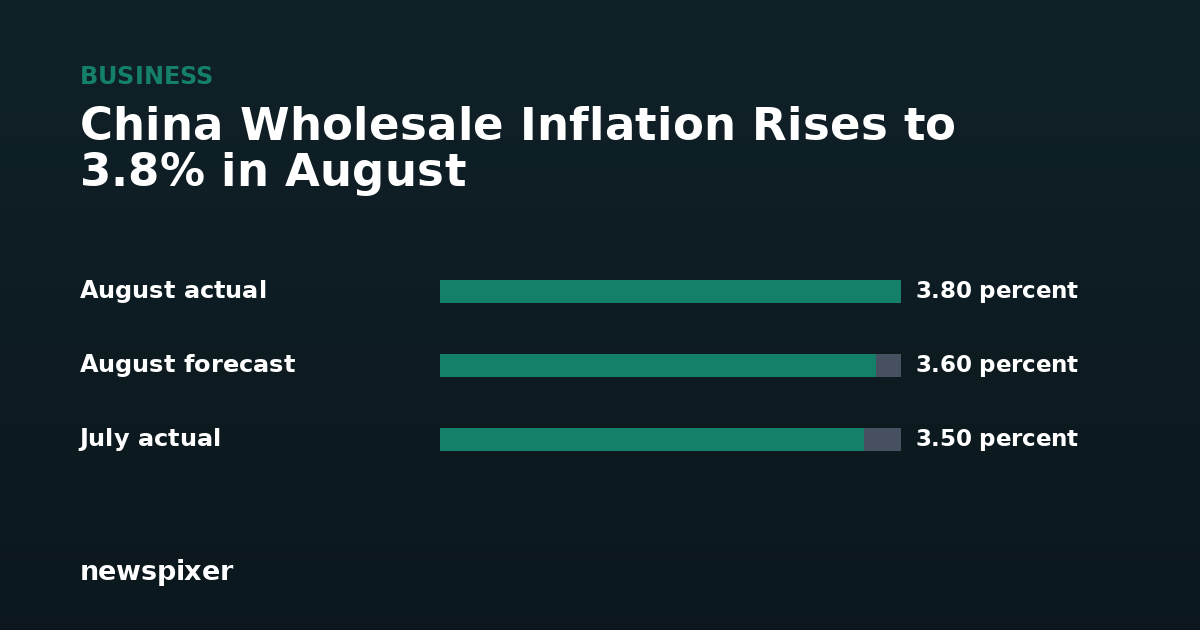
| Producer Price Index | Rose 3.8% year-on-year in August, beating the 3.6% forecast |
|---|---|
| Consumer Price Index | Grew 0.8% year-on-year in August, up from 0.5% in July |
| Core Inflation | Reached 1% year-on-year, excluding food and energy |
| Youth Unemployment | Urban rate climbed to 17.9% in July |
| Growth Forecast | Danske Bank lowered China's 2026 GDP target to 4.6% |
China’s consumer and producer inflation accelerated in August as higher global commodity prices and strong demand for high-tech goods offset persistent weakness in domestic consumption. Official statistics released on Wednesday showed factory-gate prices exceeding market expectations, driven largely by energy market disruptions and semiconductor shortages. However, economists caution that low consumer confidence and a lingering housing slump continue to weigh on the broader economy.
Wholesale and Consumer Price Figures
Data from China’s National Bureau of Statistics showed the producer price index (PPI) increased by 3.8% year-on-year in August. This surpassed the 3.6% growth projected by economists in a Reuters poll and represented an increase from July’s 3.5% reading, which was the lowest in three months.
Consumer prices also posted gains. The consumer price index (CPI) rose by 0.8% in August compared to the same period last year, matching expectations and speeding up from 0.5% growth in July. Core inflation, which excludes volatile items such as food and energy, edged up to 1% in August from 0.9% in July.
Drivers Behind the Price Movements
Dong Lijuan, chief statistician at the National Bureau of Statistics, stated in an accompanying release that the inflation rebound was driven by “volatile global commodity prices,” seasonal increases in food prices, and expanding demand within high-tech sectors.
Global crude oil prices have surged recently, influenced by conflict involving Iran. Capital Economics economist Nguyen Hoang Nam noted that producer price inflation was heavily concentrated in energy-related sectors, while consumer goods prices continued to decline due to widespread industrial overcapacity. Meanwhile, international shortages of memory chips pushed price inflation for electronics to a new high.
Weak Domestic Demand and Economic Outlook
Despite the rise in headline inflation metrics, analysts emphasize that domestic demand remains subdued. Economist Tianchen Xu of the Economist Intelligence Unit observed that service prices lacked their typical seasonal increase during the summer months due to softer tourism activity. Furthermore, government trade-in subsidies aimed at spurring household consumption have begun to lose momentum.
In response to sustained economic headwinds, Danske Bank adjusted its economic projections earlier in the week. The institution lowered its forecast for China’s 2026 GDP growth to 4.6% from 4.8%, while cutting its 2026 consumer inflation projection to 0.8% from 1%.
Allan von Mehren, chief China economist at Danske Bank, noted that without a housing recovery, “we expect household confidence to remain low and private consumption growth weak.”
Broader Economic Pressures
The rebound in inflation arrives against a backdrop of slowing momentum in the world’s second-largest economy. Growth during the second quarter decelerated to its slowest rate in over three years, while July economic indicators revealed weakening retail sales and urban investment.
Labor market conditions have also worsened, particularly for younger demographics. Official data indicated that urban youth unemployment increased to 17.9% in July, marking its highest level since August 2025. Economists at Capital Economics anticipate that producer prices could return to deflationary territory next year if energy supply conditions in the Gulf region normalize.
Background
China’s economy has faced prolonged headwinds stemming from a downturn in its property sector, high household savings rates, and subdued domestic demand. To stimulate activity, Chinese authorities implemented various consumer trade-in subsidies and policy measures earlier in the year. However, domestic consumption has struggled to maintain momentum following a brief early-year recovery, leaving economic performance heavily reliant on export demand, high-tech manufacturing, and international commodity market movements.


Leave a Reply