
Nepal-China Border Floods Leave Hundreds Dead as Barrier Lake Risk Pauses Rescue
| Death Toll | Nepal reported 579 deaths while China confirmed five fatalities in Tibet. |
|---|---|
| Missing Persons | More than 2,000 people are reported missing, including over 500 foreign nationals. |
| Secondary Threat | An upstream barrier lake containing millions of cubic meters of water overflowed, briefly halting rescue efforts. |
| Foreign Assistance | Nepal declined international search-and-rescue teams, maintaining that domestic agencies are handling operations. |
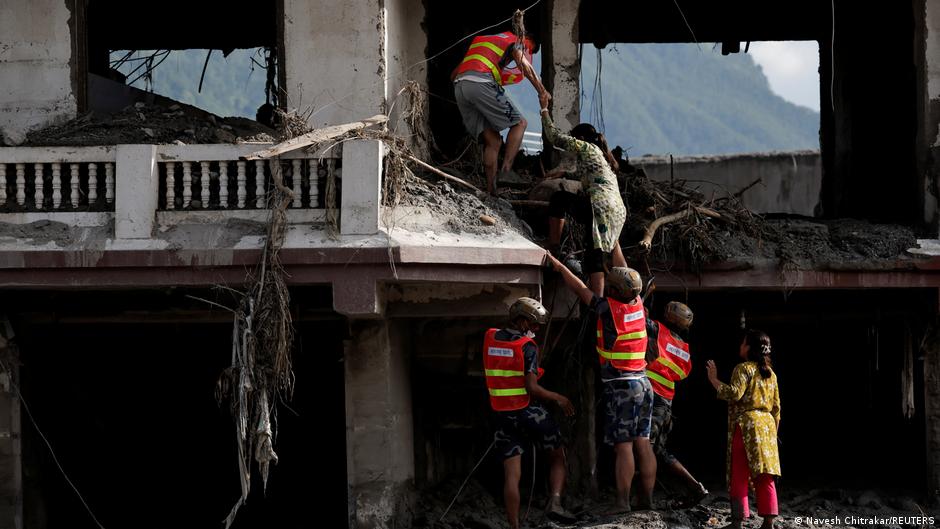
Search and rescue operations along the Nepal-China border resumed on Friday following a brief suspension caused by an overflowing barrier lake. The lake, created when debris blocked a river after a glacial collapse on Wednesday, threatened to inundate communities already devastated by flash flooding. District officials in Nepal’s Rasuwa district instructed residents to evacuate to higher ground as river levels surged, though local authorities later indicated that the immediate danger had temporarily diminished.
The total fatalities from the disaster have increased significantly. Nepalese officials reported that the confirmed death toll in the country rose to 579, up from 390 recorded on Thursday. Across the border in Tibet, Chinese authorities updated their official fatal casualties from three to five. More than 2,000 people are reported missing across the disaster zone, among them over 500 foreign citizens originating from more than 30 countries.
Humanitarian organizations have raised concerns over secondary hazards and emerging health risks. The International Red Cross reported that more than 93,000 people require urgent aid, noting that relief vehicles were obstructed by the barrier lake. David Fisher, a spokesman for the organization, said, “We’re of course very concerned about a secondary flood,” while Kamal Kishore of the United Nations Office for Disaster Risk Reduction stated, “The disaster is not yet completely over.” Additionally, World Health Organization spokesman Tarik Jasarevic warned that overcrowding and damaged infrastructure could trigger outbreaks of infectious diseases.
Chinese water resource officials measured the barrier lake at roughly 150 meters in length and 40 to 50 meters in depth. The reservoir held approximately 2 million cubic meters of water on Thursday and was projected to collect an additional 3 million cubic meters. Situated more than 10 kilometers upstream and 1,000 meters above the damaged Gyirong Port border post, the lake poses a continued risk. An eight-person engineering crew has been deployed by China to survey the structure and prepare a drainage channel to alleviate water pressure.
Despite the scale of the crisis and offers of assistance from several nations—including India, China, the United States, Britain, Japan, South Korea, Sri Lanka, and Bangladesh—Nepal has turned down international search-and-rescue teams. Foreign Ministry spokesperson Lok Bahadur Chhetri confirmed that domestic security services were managing the operations, stating, “For now we don’t require such help.” South Korea, which has nine citizens missing and ten stranded at a flooded hydropower plant, reported that it remains in discussions with Nepalese authorities regarding aid deployment.
Background
The Himalayan border region between Nepal and China is vulnerable to sudden glacial lake outburst floods and landslides, particularly during monsoon season and periods of rapid glacial melting. Glacial collapse events occur when ice blocks or moraines holding back meltwater give way, releasing massive volumes of water, mud, and rock into mountain river valleys below. These events frequently disrupt key overland trade routes and border crossings, such as Gyirong Port, and severe topography combined with unstable weather often complicates emergency response efforts in the high-altitude terrain.


Leave a Reply