
Thousands of Low-Income UK Families Miss Out on Food Aid

| Program | NHS Healthy Start |
|---|---|
| Eligibility threshold | Monthly earnings of £408 or less while on Universal Credit |
| Payment rates | £4.65 weekly for pregnant women and children under 4; £9.30 for infants under 1 |
| Regional impact | 6,149 eligible families unenrolled in North East England and Cumbria |
| Lowest enrolment rate | 64% in former Eden Council area |
| Data publication | Suspended by NHS since January 2023 due to tracking inaccuracies |
Thousands of low-income families in northern England are failing to receive government support intended to help purchase healthy food and milk for young children, anti-poverty charities have warned. Participation in the National Health Service scheme drops as low as 64 percent in certain districts, leaving thousands of eligible parents without financial aid as grocery costs rise.
Regional Gaps in Enrolment
Under the NHS Healthy Start scheme, households in England receiving Universal Credit with monthly net earnings of £408 or less can claim weekly financial allowances. Pregnant women and parents with children under four years old are eligible for £4.65 per week, while households with infants under 12 months can receive £9.30 weekly to spend on fresh fruit, vegetables, and baby formula.
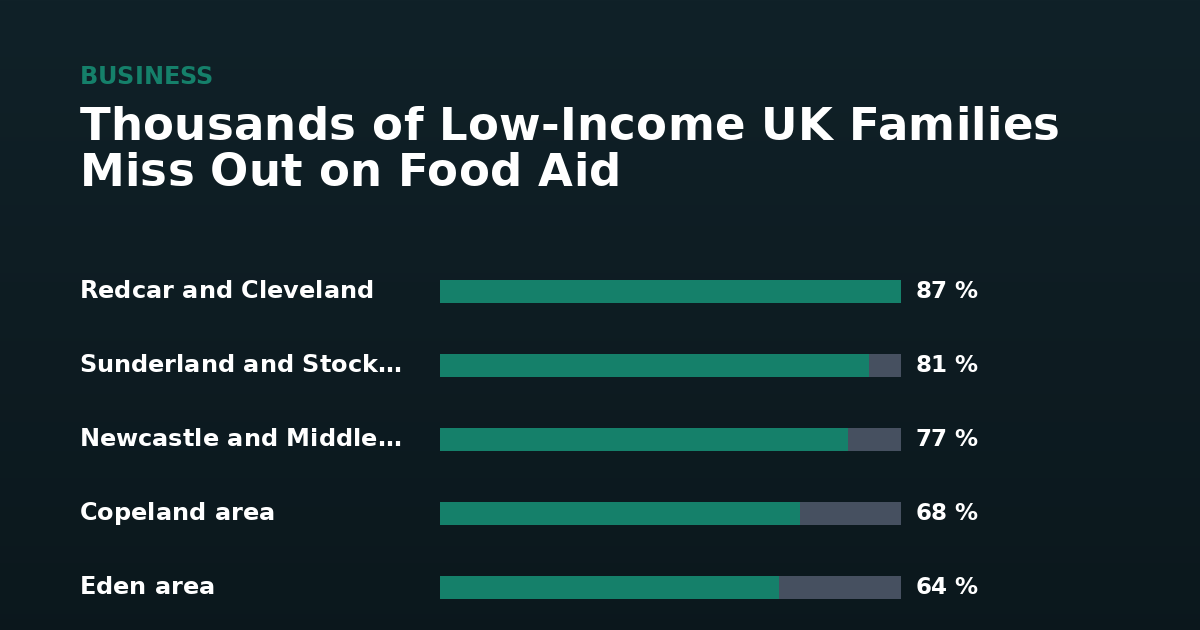
Regional figures indicate significant variation in participation across northern England. In the former Eden Council area, 64 percent of eligible families are enrolled, while participation is 68 percent in the former Copeland Council area. Uptake reaches 77 percent in Newcastle and Middlesbrough, and 81 percent in Sunderland and Stockton. Redcar and Cleveland Council registered the highest enrolment at 87 percent. Across the North East and Cumbria, 6,149 qualifying families are missing out on payments.
Charity Demands and Inflation Concerns
Advocacy groups including Feeding Britain, Sustain, and The Food Foundation are calling for structural changes to the program. Andrew Forsey, director of Newcastle-based Feeding Britain, urged the government to implement automatic enrolment using existing state data to “lift some of the burden off parents’ shoulders.”
Campaigners also note that assistance rates have failed to match rising food inflation. Penny Walters, a worker for Feeding Britain, described the £9.30 weekly infant rate as “worthless” against current market prices, pointing out that it covers only a single tin of formula per week. Frontline staff in the region reported cases of severe distress, including an infant admitted to a hospital in Newcastle with malnutrition after being fed sugar water due to lack of funds.
Data Disruption and Political Calls
Tracking the problem has been hindered by a lack of updated official metrics. The NHS stopped releasing enrolment statistics in January 2023 after discovering an error in its reporting system, which has yet to be resolved. As a result, local authorities and community organizations cannot identify which families are missing assistance.
Political representatives have urged further action. Emma Lewell, the Labour Member of Parliament for South Shields, stated that unclaimed funds designated for the scheme should not return to the Treasury, advocating for mechanisms to ensure allocated money reaches eligible parents.
Background
The Healthy Start scheme is administered by the National Health Service in England to reduce health inequalities by helping low-income parents afford nutritional essentials. Broad food price inflation in the United Kingdom over recent years has placed increased pressure on low-income households, raising reliance on state support programs.


Leave a Reply