
UK Air Traffic Control Faces Backlash After Glitches

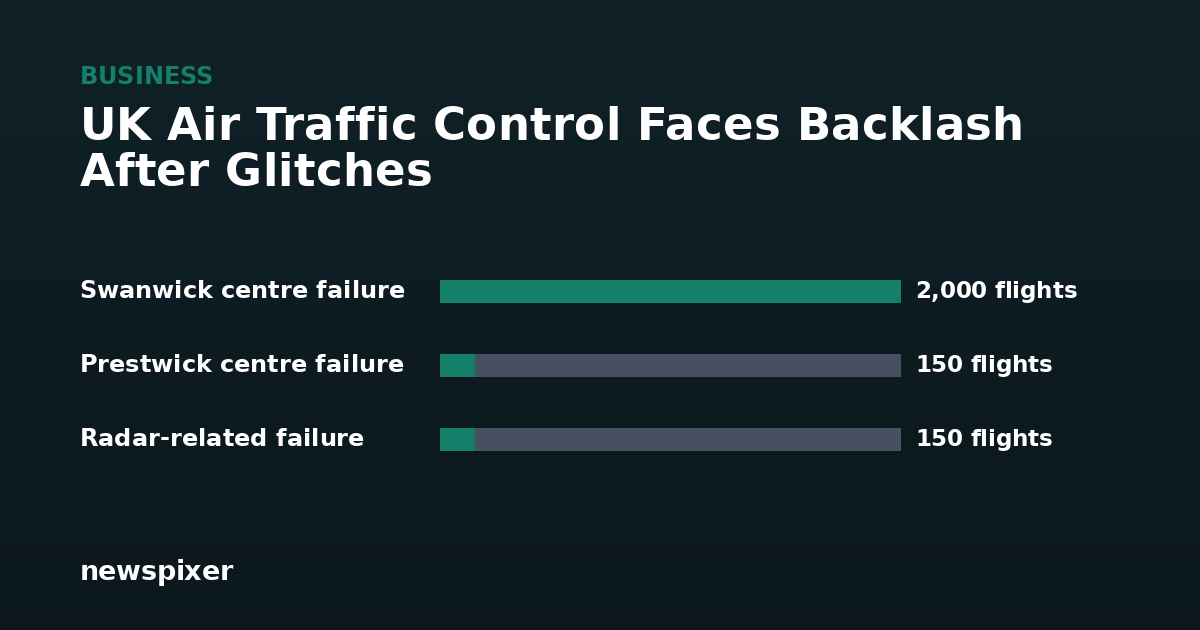
| Latest incident | 150 flights cancelled following a connectivity issue at Prestwick control centre |
|---|---|
| Earlier incident | More than 2,000 flights cancelled due to a software flaw at Swanwick |
| Historical impact | 700,000 passengers affected by an August 2023 flight plan breakdown |
| Daily traffic | Nats manages up to 8,000 flights per day in UK airspace |
| Investigation | Civil Aviation Authority conducting a six-month independent review |
The United Kingdom’s air traffic control provider is facing intense scrutiny from major airlines following two technical outages within a fortnight that stranded thousands of travellers. The repeated disruption has raised broader questions regarding the stability and funding of critical national aviation infrastructure.
The latest incident occurred on Monday at the Prestwick control facility in Scotland, which oversees airspace across Scotland, northern England, and Northern Ireland. Aviation analytics firm Cirium reported that a connectivity problem at the site led to roughly 150 flight cancellations and widespread delays affecting tens of thousands of passengers.
Recent Disruptions and Technical Causes
Monday’s breakdown followed a far larger failure earlier in the month at the primary Nats control hub in Swanwick, Hampshire. That event forced the cancellation of more than 2,000 flights across two days, leaving hundreds of thousands of passengers stranded in overseas terminals or forced to sleep on UK airport floors. Nats attributed the Swanwick shutdown to an undetected software flaw triggered by a precise sequence of events occurring within a single millisecond, while maintaining that the subsequent Prestwick failure was an unrelated connectivity issue.
The dual outages follow earlier technical troubles at the provider. In August 2023, a system crash triggered by an error in a single aircraft flight plan disrupted travel for 700,000 passengers over a public holiday weekend. Two years later, a four-hour radar fault forced 150 flight cancellations. The agency oversees some of the busiest air traffic corridors in Europe, including routes serving London Heathrow and London Gatwick, handling up to 8,000 flights each day.
Airlines Demand Action and Leadership Changes
Airlines have voiced sharp frustration over the recurring operational breakdowns. Steve Heapy, chief executive of Jet2, remarked that the national provider’s performance was “simply not good enough for this critical national infrastructure.” Carrier Easyjet stated that the second glitch “calls into question the resilience of Nats’ systems” and urged decisive measures to prevent further failures.
Budget carrier Ryanair has repeatedly demanded the resignation of Nats chief executive Martin Rolfe, urging Transport Secretary Heidi Alexander to intervene if he refuses to step down. According to industry sources, airline executives are angry at absorbing the financial burden of passenger refunds and accommodation costs caused by control failures.
In response, a Nats spokesperson apologised for the recent disruption, noting that technology “can and sometimes does fail” while adding that safety “is always our first priority.” Rolfe confirmed he has no intention of resigning, explaining that in systems of such high complexity, faults are extremely intricate. He noted that any issue occurring within such complex software is “going to be incredibly complicated and probably difficult to understand at the time.”
Government Inquiry
Transport Secretary Heidi Alexander characterised the widespread flight cancellations in early September as “completely unacceptable.” However, the government has not indicated plans to enforce a change in leadership at the air traffic manager.
The British government has directed the Civil Aviation Authority to conduct an independent investigation into the initial September failure. The review is expected to take six months to complete, with regulatory or structural changes unlikely to occur before its findings are published.
Background
Nats is the primary provider of air traffic control services in the United Kingdom, operating major radar and control centres at Swanwick in Hampshire and Prestwick in Ayrshire. The public-private partnership coordinates commercial, freight, and military air movements through UK airspace and over parts of the North Atlantic.


Leave a Reply