
Biggest Fantasy Football Busts of 2026: 12 Players to Avoid at Their ADP
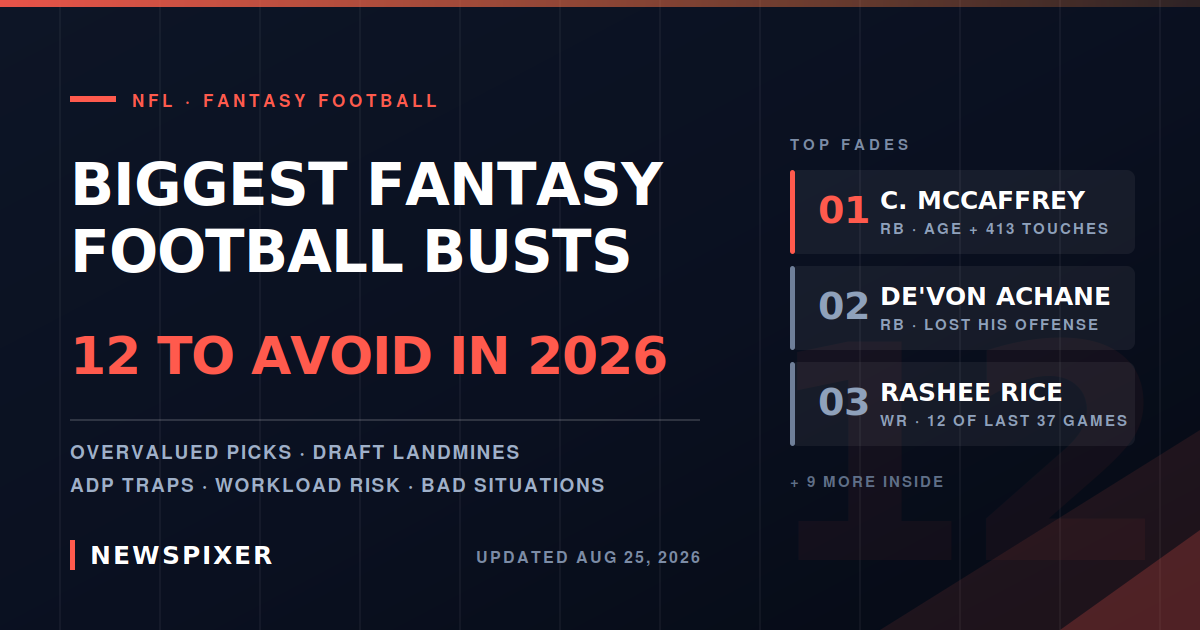
Winning a fantasy league is rarely about the picks you nail. It is about the picks you do not blow.
One busted second-rounder can be absorbed. Two will sink a season, because the roster spots you burned on them were the ones that should have held your league-winning fliers. With the 2026 NFL season kicking off September 10 and home leagues drafting nightly, this is Newspixer’s list of the biggest fantasy football bust candidates — the players whose average draft position has drifted well past what the evidence supports.
First, What “Bust” Actually Means
No player on this list is undraftable. That is not what a bust is.
A bust is a player whose price has outrun his projection. Christian McCaffrey at pick 30 is a bargain. Christian McCaffrey at pick 6 is a problem. The name does not change — the cost does. Every player below is someone we would happily roster two or three rounds later than where they are currently going.
Full disclosure: several of these names appear inside the top 25 of our own 2026 top 200 rankings. Ranking a player and being nervous about him are not contradictory positions. This piece is the cross-examination.
Tier 1: First-Round Landmines
Christian McCaffrey, RB, San Francisco 49ers
McCaffrey scored more PPR points than any player in football last season — 416.6. That is precisely the problem.
He turned 30 this offseason and absorbed a career-high 413 touches to get there. The last time McCaffrey crossed 400 touches in a season, he missed the overwhelming majority of the two years that followed. He has also missed camp time this August with muscle tightness, which is the exact phrase that preceded his lost 2024 campaign.
None of this means he will get hurt. It means you are paying a top-six price for a 30-year-old back with a mileage profile that historically breaks. The upside is a repeat RB1 finish. The downside is nine games.
De’Von Achane, RB, Miami Dolphins
Achane got paid this offseason. Everything around him got worse.
Mike McDaniel — the coach who built Miami’s entire offense around Achane as both a rusher and a short-area receiving weapon — is gone. So is Tua Tagovailoa, an immobile quarterback who leaned on checkdowns and dump-offs as heavily as any starter in football. In their place: Malik Willis, who will take off and run himself, and coordinator Bobby Slowik, whose offense projects to pass at a meaningfully higher rate than Miami’s 55 percent mark last season.
Fewer designed touches, fewer checkdowns, a worse offensive environment, and a receiving corps stripped to the studs after Jaylen Waddle was traded and Tyreek Hill was released. Achane is still talented. He is being drafted like the situation did not change, and the situation changed completely.
Tier 2: The Running Back Traps
Omarion Hampton, RB, Los Angeles Chargers
Hampton’s talent is not in question. His workload is.
The Chargers went out and added Keaton Mitchell, a legitimate change-of-pace back with real receiving ability, which caps the exact category of touches that separate an RB1 from an RB2 in PPR. Hampton is being drafted as a locked-in workhorse by managers who have not priced in a committee. If Mitchell handles even 30 percent of the passing-down snaps, Hampton’s ceiling collapses to touchdown-dependent RB2 territory.
Cam Skattebo, RB, New York Giants
The rehab story is genuinely good — Skattebo came back from an ankle dislocation and fibula fracture faster than anyone expected, and he has climbed to roughly RB18 in ADP as a result.
The underlying numbers are not good. He posted minus-0.13 EPA per rush as a rookie and, among backs with at least 100 carries, finished outside the top 25 in yards per carry, success rate and explosive run rate. That is inefficiency across every axis. Then New York signed Najee Harris in August, a move that reads as insurance against exactly the workload Skattebo’s ADP assumes.
A contact-seeking runner coming off a serious lower-leg injury, who was not efficient before the injury, now sharing a backfield. That is three risk factors stacked.
Jeremiyah Love, RB, Arizona Cardinals
The No. 3 overall pick has been the summer’s most fashionable rookie, and the market has not caught up to his August.
Love is dealing with a high ankle sprain that cost him preseason reps and has him in real doubt for the opener. Tyler Allgeier is currently lined up to start Week 1, and Arizona’s backfield still includes James Conner and Trey Benson. High ankle sprains are notoriously slow to resolve for running backs specifically — burst and cutting are the last things to return.
The long-term case for Love is excellent. The 2026 case is being drafted at a price that assumes he is healthy and unchallenged, and right now he is neither.
Tier 3: Wide Receivers Priced on Hope
Rashee Rice, WR, Kansas City Chiefs
The per-game production is real: roughly 6.4 catches and 71.6 receiving yards per game over the past two seasons. The availability is not. Rice has played in just 12 of Kansas City’s last 37 regular-season games, and he enters 2026 rehabbing knee surgery with a legal situation that lingered into the summer and a possible league suspension still unresolved.
Layer on the quarterback question — Patrick Mahomes is working back from a torn ACL and LCL — and the reported plan to use Kenneth Walker III heavily in the screen game, and you have a WR2 price attached to a player who might give you ten games of a diminished offense.
Marvin Harrison Jr., WR, Arizona Cardinals
The “post-hype breakout” label is doing enormous work here. Harrison’s 2025: 41 catches, 608 yards and four touchdowns across 12 starts, playing through a string of injuries.
Meanwhile, Michael Wilson broke out in the same offense, and Trey McBride remained the target hog. Jacoby Brissett — who held out most of the summer before reworking his deal — was efficient enough to finish QB16 in 14 starts, so the offense was not the problem. Harrison was. Until he proves the third year is different, he is a WR4 price masquerading as a WR2.
Terry McLaurin, WR, Washington Commanders
This is the most uncomfortable name on the list, because McLaurin has been a model of professionalism in bad offenses for years. But the record is the record: he has finished WR20 or worse in PPR points per game in six of his seven NFL seasons — and he did that while facing essentially zero target competition.
Washington signed Stefon Diggs on August 7. For the first time in his career, McLaurin has a legitimate rival for looks in a Jayden Daniels offense that does not throw at volume. Diggs at his current ADP is the better bet of the two.
Tier 4: Quarterbacks and Tight Ends
Josh Allen, QB, Buffalo Bills
Allen is the correct QB1. He is also frequently the wrong pick.
He is being taken ahead of Brock Bowers, Nico Collins and A.J. Brown in a lot of drafts. In a one-quarterback league, that is a structural error — the gap between Allen and the QB7 is far smaller than the gap between an elite tight end and a replacement one. Take Allen if he falls. Do not reach into the third round for him.
Jalen Hurts, QB, Philadelphia Eagles
Hurts averaged 18.7 fantasy points per game in 2025 — the first time he has finished below 20.8 as a full-time starter — despite a career-high 25 passing touchdowns. The reason is the one that matters most for his fantasy profile: his rushing touchdowns fell into single digits for the first time since his rookie year.
Now A.J. Brown is in New England. Philadelphia added pass catchers, but none of them replace a receiver who commanded a quarter of the targets. Hurts without the tush-push touchdown volume and without Brown is a mid-range QB2.
Harold Fannin Jr., TE, Cleveland Browns
Fannin’s splits are the whole story. In games with eight or more targets last season, he averaged 16.9 PPR points. In the 11 games with seven or fewer, that dropped to 9.3.
So the question is simply: will he get eight targets? Cleveland then drafted KC Concepcion and Denzel Boston. That is meaningful new target competition in a passing offense that was not generous to begin with. Tyler Warren costs a few picks more; Sam LaPorta costs nearly two rounds less. Both are better bets.
Dalton Kincaid, TE, Buffalo Bills
Kincaid was a popular sleeper last summer and finished TE20. Buffalo has since traded for D.J. Moore, giving Josh Allen the true No. 1 receiver he has lacked since 2023 — and giving Kincaid one more mouth to feed. The breakout keeps getting projected and never arrives.
One Player We Are Not Calling a Bust
Garrett Wilson, WR, New York Jets. He appears on plenty of do-not-draft lists this month, mostly on the strength of skepticism about Geno Smith’s pocket mobility. We think that is the wrong read.
Before his injury last season, Wilson was the WR6 in points per game across the first five weeks while posting a career-high yards per route run. In his three healthy NFL seasons he never finished worse than sixth in total targets. Even in a truncated 2025 he averaged 8.4 targets per game. Target volume that stable does not evaporate because of a quarterback change. At WR20, he is fine.
How to Avoid Drafting Busts
- Price the risk, do not just note it. “He might get hurt” is not analysis. “He is a 30-year-old back off 413 touches, so I need a two-round discount” is.
- Ask what changed. Achane, Hurts and McLaurin all lost something concrete this offseason. Last year’s stat line is a description of last year’s situation.
- Distrust splits-dependent producers. Fannin’s ceiling requires a target volume nobody has promised him.
- Do not pay for talent you cannot start. Rice’s per-game rate is excellent and largely irrelevant if he plays ten games.
- Take the discount, not the fade. Every name here becomes a good pick eventually. Have a round in mind where you would happily buy.
FAQ
Who is the biggest fantasy football bust candidate in 2026? Christian McCaffrey, purely on cost. He is the reigning PPR scoring leader being drafted at a top-six price coming off a career-high 413 touches at age 30.
Should I draft Rashee Rice in 2026? Not at his current WR11-ish price. He has played 12 of 37 possible games over two seasons and enters the year with knee, legal and quarterback uncertainty. He is worth it two rounds later.
Is Jeremiyah Love a bust? For 2026 redraft, he is overpriced while dealing with a high ankle sprain, with Tyler Allgeier set to open as Arizona’s lead back. In dynasty, he remains the clear 1.01.
When should I draft a quarterback in 2026? Round 7 or later in one-QB leagues. Drake Maye, Justin Herbert and Dak Prescott offer most of Josh Allen’s ceiling at a fraction of the draft capital.
Is Terry McLaurin really a bust? He is a fine WR3. He is being drafted as a WR2, and the arrival of Stefon Diggs makes that harder to justify than at any point in his career.
Bust lists move fast. Check back before your draft — ADP shifts, and a Saturday injury report can turn a fade into a value overnight.


Leave a Reply