
What Is the NFL Franchise Tag and How Does It Work?
Every February, a handful of NFL players find out they aren’t reaching free agency after all. Their team has applied the franchise tag — a mechanism that keeps a player for one more season on a one-year contract, whether he wants to stay or not.
It’s one of the most consequential tools in the sport’s labour system, and one of the least understood.
The basic idea
A franchise tag is a one-year contract offer a team can place on one of its own players who would otherwise become a free agent. The player can’t leave for another team on ordinary terms. In exchange, he’s paid a figure calculated from what the best-paid players at his position earn.
For 2026, the window ran from 17 February to 3 March at 4:00 PM ET. Teams can use one tag per year.
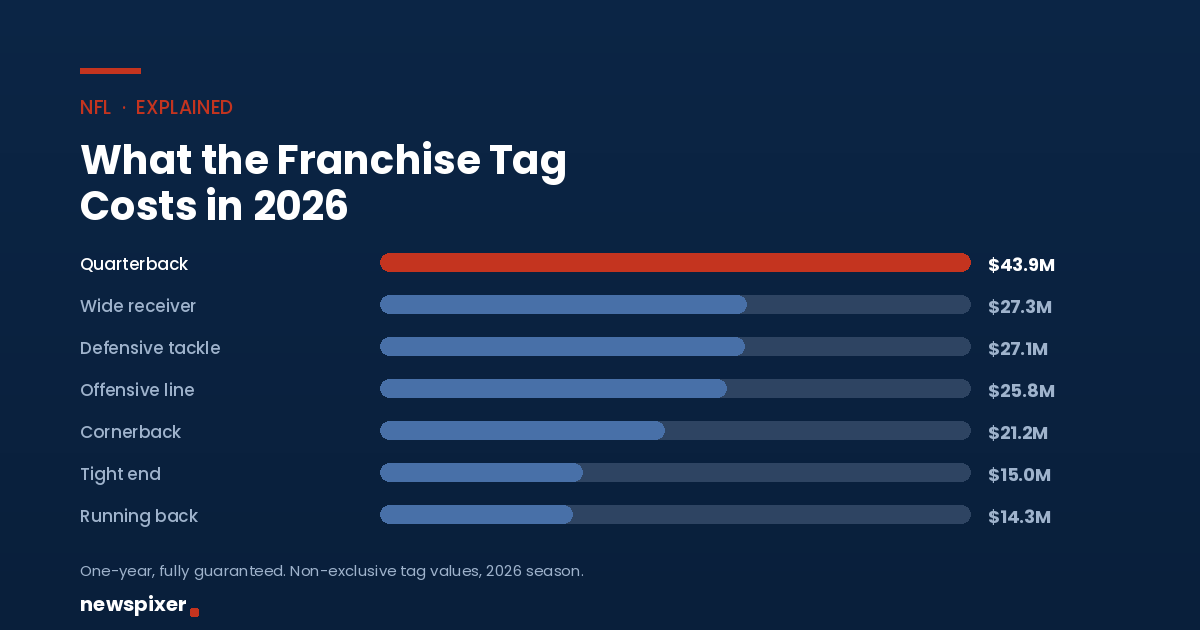
The money is real. A quarterback tagged in 2026 earns $43.895 million for the season, fully guaranteed once he signs. That’s the entire point of the trade-off: a player loses the freedom to choose his employer, and is compensated at close to the top of his position’s market.
The three types
This is where most explanations get muddled, because the three tags do genuinely different things.
Non-exclusive franchise tag — by far the most common, and what people usually mean by “the franchise tag.” The player is paid the greater of two figures: the average of the top five salaries at his position over the previous five seasons, calculated as a percentage of the salary cap, or 120% of his own previous salary.
Crucially, he can negotiate with other teams. If another club signs him to an offer sheet, his original team can either match it or let him go — and if they let him go, they receive two first-round draft picks as compensation. In practice that price is steep enough that offer sheets are rare.
Exclusive franchise tag — the player cannot negotiate with anyone. The tagging team holds sole rights. Because that’s more restrictive, it costs more: the average of the current top five salaries at the position, rather than a five-year historical average.
It’s used sparingly, generally on players another team would happily surrender two first-round picks to acquire. Quarterbacks, mostly.
Transition tag — the cheapest of the three, calculated from the average of the top ten salaries at the position rather than the top five. The original club gets a right of first refusal on any offer sheet, and five days to match it.
The significant catch: if they decline to match, they get nothing. No draft picks, no compensation. That asymmetry is why the transition tag is used far less often than the franchise tag.
What each tag costs in 2026
With the salary cap set at $301.2 million, these are the confirmed figures:
| Position | Franchise | Transition |
|---|---|---|
| Quarterback | $43.895M | $37.833M |
| Defensive tackle | $27.127M | $22.521M |
| Wide receiver | $27.298M | $23.852M |
| Linebacker | $26.865M | $21.925M |
| Offensive line | $25.773M | $23.392M |
| Defensive end | $24.434M | $21.512M |
| Cornerback | $21.161M | $18.119M |
| Safety | $20.149M | $16.012M |
| Tight end | $15.045M | $12.687M |
| Running back | $14.293M | $11.323M |
| Kicker / punter | $6.649M | $6.005M |
The gap between quarterback and every other position tells you something about how the sport values them. A tagged quarterback costs roughly three times a tagged running back.
Why teams actually use it
The honest answer is that the tag is usually a delaying tactic rather than a plan.
Most teams don’t want to pay a player $27 million for one year with nothing after it. They want a long-term extension at a more manageable annual figure. The tag buys negotiating time: once applied, the two sides have until 15 July to agree a multi-year deal.
That deadline matters. If no extension is reached by then, the player can only sign the one-year tender, and cannot negotiate an extension again until his team’s regular season ends.
This plays out most years. In 2026, Cincinnati tagged receiver Tee Higgins and Kansas City tagged guard Trey Smith — both then signed four-year deals. The tag was the pressure that produced the contract, not the outcome.
The other common use is simpler: a team genuinely can’t afford a long-term deal but can’t afford to lose the player either. One more year buys time to restructure elsewhere on the roster.
What players can do about it
Less than you might expect, but not nothing.
Refuse to sign. A tagged player isn’t obliged to sign the tender. Le’Veon Bell famously sat out the entire 2018 season rather than play on the tag. He forfeited the salary, but reached free agency the following year.
Wait for it to be rescinded. Teams can withdraw an unsigned tag at any point, which makes the player an unrestricted free agent immediately. Carolina did this with cornerback Josh Norman in 2016.
Once signed, though, the tender is fully guaranteed for skill, cap and injury — the player is paid regardless of performance or injury that season.
Some teams barely touch it
Philadelphia haven’t used the franchise tag since DeSean Jackson in 2012 — the longest current streak in the league. Indianapolis went nearly as long before breaking their run in 2024.
That’s a philosophical position as much as a financial one. The tag creates a player who is well paid but not committed to, which some front offices regard as worse for a locker room than either extending a player properly or letting him leave.
The short version
The franchise tag keeps a player one more year on a guaranteed, expensive, one-year deal. It exists to give teams leverage in contract negotiations, and it usually works — most tagged players sign long-term extensions before ever playing under it.
Leave a Reply