
US bans Canadian alcohol, dairy and motorbikes

| Effective date | 29 September 2026 |
|---|---|
| Banned goods | Alcoholic spirits, whey, non-alcoholic beer, motorbikes |
| Trade impacted | Approximately $1bn (0.25% of Canadian exports to US) |
| Catalyst | Canada's retaliatory tariffs taking effect on US goods |
The United States has announced import bans on a selection of Canadian products, including alcoholic spirits, motorbikes, and certain dairy items, following the implementation of retaliatory tariffs by Ottawa. President Donald Trump signed executive orders establishing the bans, which are scheduled to take effect on 29 September 2026.
The White House stated that the measures were introduced because Canada was discriminating against US companies by placing restrictions on American goods without applying similar limits to other nations. In response, Canadian Trade Minister Dominic LeBlanc described the US actions as “unjustified” and stated that Ottawa would focus on “building strength at home, diversifying our partnerships abroad” while attempting to resolve trade disputes in good faith.
Scope of the Bans and Economic Impact
The executive orders impose complete import bans on specific items, such as non-alcoholic beer and whey, alongside motorbikes and spirituous liquors. Other goods, including cheeses, cheese substitutes, and motorboats, will face higher tariff rates rather than outright bans.
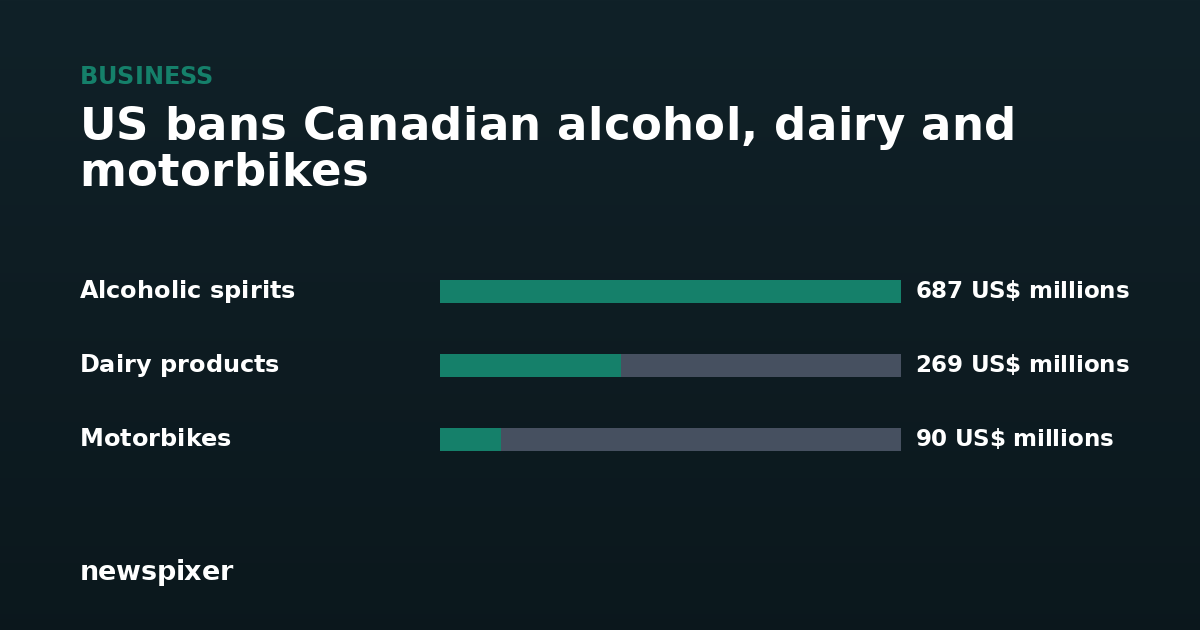
According to UN trade data compiled by Trading Economics, Canada exported $687m in alcoholic spirits, $269m in dairy products, and $90m in motorbikes to the US in 2025. Despite those figures, Capital Economics chief North America economist Stephen Brown calculated that the bans cover roughly 0.25% of Canada’s total exports to the US. Brown noted that the policy appears designed for “inflicting economic pain rather than raising revenue.”
Trade analyst Deborah Elms of the Hinrich Foundation estimated the total value of affected goods at approximately $1bn, describing the initial overall economic impact as modest, though individual businesses reliant on US sales could face significant disruption.
Escalating Tariff Battle
The new bans mark the latest escalation in a months-long bilateral dispute. Previous trade talks collapsed in late August 2026 without a agreement, and no further negotiations have been scheduled.
Prior to the latest US announcement, Washington had levied 50% tariffs on approximately $20bn of Canadian exports, hitting sectors such as furniture, wine, and sporting gear. Canada responded with retaliatory duties on US products—including steel, clothing, and furniture—that took effect after midnight on Tuesday. Canadian Prime Minister Mark Carney characterized Ottawa’s counter-measures as “dollar-for-dollar” duties, acknowledging that pivoting away from trade with the US “will come at a cost.”
Wider Tensions and Industry Targets
The measures place renewed pressure on Canada’s supply-managed dairy sector, which operates under national production quotas, price controls, and import restrictions. Economics lecturer Scott French from the University of New South Wales noted that Washington intentionally targeted politically sensitive industries to force concessions from Canadian leaders, adding that consumers on both sides of the border would suffer economic losses due to tightly integrated cross-border supply chains.
Tensions have extended beyond agricultural and consumer trade. President Trump signaled potential further action against Canadian aerospace manufacturer Bombardier, warning that its aircraft could be barred from US sales unless assembly is relocated to the US. Bilateral friction has also spilled into symbolic disputes, including an August declaration by the US president seeking to rename Lake Ontario as Lake America, alongside ongoing consumer boycotts of US goods across Canada.
Background
Canada is the second-largest trading partner of the United States after Mexico, with more than two-thirds of all Canadian exports traditionally destined for US markets. The two North American nations share highly integrated supply chains across manufacturing, agriculture, and consumer goods. Recent trade disputes have disrupted this long-standing economic relationship, leading to reciprocal tariffs, product bans, and retaliatory measures across multiple commercial sectors.


Leave a Reply