
London dealmakers collect over £1bn in takeover boom

| Total UK M&A value in 2026 | £100 billion ($132.9 billion) |
|---|---|
| Advisory fees paid | Over £1.2 billion |
| Top financial advisor | JP Morgan (14 deals worth £67.6 billion) |
| Top legal advisor | Slaughter and May |
| UK lender tax rate | 28% |
| UK stock listings in H1 2026 | 7 listings raising £577 million |
London-based investment bankers, lawyers, and accountants have gathered more than £1.2 billion in advisory fees following a sharp rise in corporate acquisitions across the United Kingdom in 2026. According to data from the London Stock Exchange, the total value of mergers and acquisitions involving UK-listed companies surged by 175 percent to reach $132.9 billion (£100 billion). The takeover boom, propelled primarily by private equity funds and North American corporate buyers seeking undervalued British businesses, has brought record revenues to City financial and legal firms while drawing political scrutiny.
Surge in Foreign Acquisitions and Advisory Payouts
The expansion in corporate dealmaking was led by major international investment institutions and legal advisors. London Stock Exchange figures indicate that JP Morgan served as the primary financial advisor in the market, handling 14 separate transactions with a combined value of $89.4 billion (£67.6 billion). Slaughter and May ranked as the top legal advisor by transaction activity.
Among the largest individual transactions was the £10.6 billion acquisition of testing firm Intertek by the private equity group EQT. That single deal is projected to yield over £370 million in combined advisory fees. Banking institutions including Morgan Stanley, Barclays, and Deutsche Bank advised EQT, while Goldman Sachs, JP Morgan Cazenove, and PJT Partners represented Intertek. The £1.2 billion fee total reported in official regulatory disclosures reflects completed transactions; additional unbilled or pending deals, such as Apollo Global Management’s £5.7 billion agreement to acquire airline easyJet, are expected to push overall advisor earnings higher.
Uncapped Bonuses and Legal Firm Earnings
Earnings across London’s professional services sector were further augmented by recent regulatory changes regarding variable compensation. Following the UK government’s decision in late 2023 to eliminate the policy limiting banking bonuses to twice an employee’s base salary, financial firms established independent caps. Certain major institutions, including Goldman Sachs, now permit variable bonus payouts reaching up to 25 times annual base salaries.
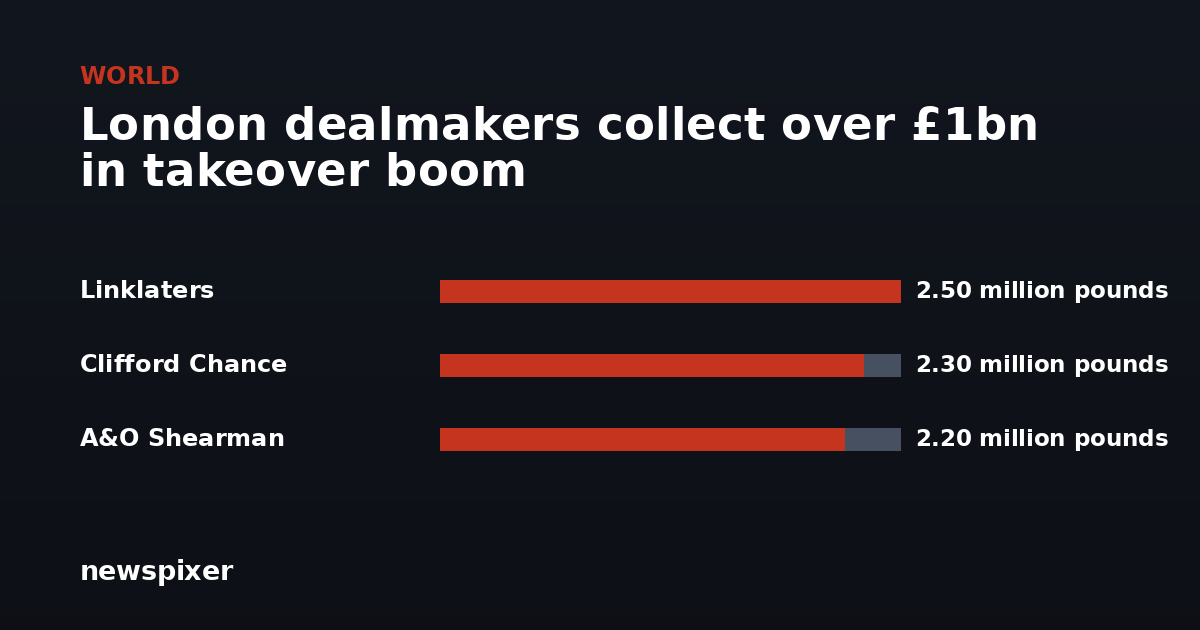
Senior corporate lawyers have also recorded historic earnings, with equity partners at top-tier London law firms reporting record revenue shares in the year ending April. Partners at Linklaters received an average payout of £2.5 million, while partners at Clifford Chance averaged £2.3 million and those at A&O Shearman averaged £2.2 million. At the advisory firm Evercore, senior dealmakers averaged £2 million in annual compensation, with the firm’s highest-earning individual collecting £16.2 million.
Taxation Debates and Market Structure Concerns
The elevated compensation packages have drawn criticism from labor representatives against the backdrop of broader economic pressures. Charlotte Brumpton-Childs, national secretary at the GMB union, questioned the disparity, noting that brokers earn massive sums “while the people who keep this country moving struggle to make ends meet.” Trades Union Congress general secretary Paul Nowak renewed calls for a windfall tax on banking profits, arguing that “if banks can afford bonanza payouts,” they possess the financial capacity to contribute more in taxes.
At the same time, the financial services sector is actively resisting potential tax increases. JP Morgan chief executive Jamie Dimon and industry trade body UK Finance have voiced warnings to Andy Burnham and Chancellor John Healey ahead of the government budget scheduled for 28 October. Lenders in the UK currently face a 28 percent corporation tax rate—comprising the standard 25 percent tax rate plus a dedicated bank surcharge. Concurrently, industry analysts have expressed concern over the shrinking pool of public companies on the London Stock Exchange, where only seven initial public offerings occurred during the first six months of 2026, raising a total of £577 million according to data from consultancy EY.
Background
The UK financial sector was subjected to tighter regulatory oversight following the 2008 global financial crisis, including European Union rules that capped banker bonuses at twice annual base salaries. The UK government repealed this rule in late 2023 as part of post-Brexit financial deregulation aimed at boosting London’s global competitiveness. Corporate takeover activity in the UK has frequently faced public debate regarding foreign ownership of domestic assets, the tax contributions of financial institutions, and the overall liquidity of London’s equity capital markets.


Leave a Reply