
PPR vs Half-PPR vs Standard: Fantasy Football Scoring Formats Explained
Two managers draft the same running back. One finishes the week with 18.5 points, the other with 22.5. Neither made a mistake, and neither platform is broken.
They just play in different scoring formats — and that single difference reshapes which players are worth drafting, where they should go, and how you build a roster. If you have ever wondered why one ranking list has a slot receiver 20 spots higher than another, this is why.
Here is everything you need to know about PPR, half-PPR and standard scoring before your 2026 draft.
The Only Thing That Actually Changes
This is the part most explainers bury, so let’s lead with it.
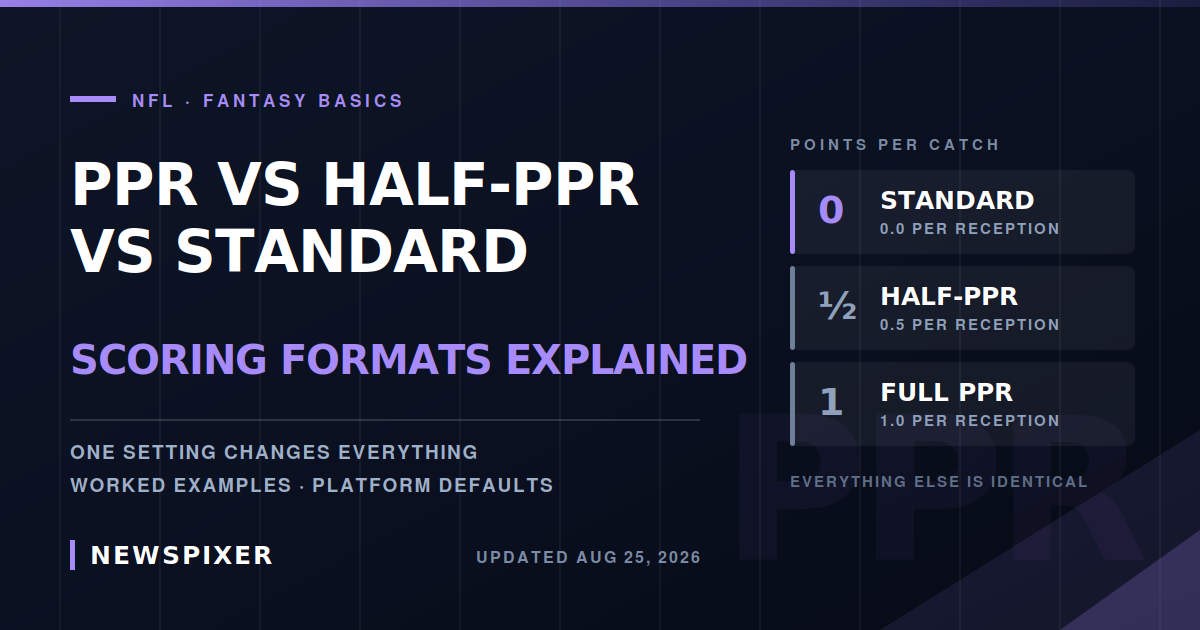
All three formats are identical except for one setting: how much a reception is worth.
- Standard: 0 points per catch
- Half-PPR: 0.5 points per catch
- Full PPR: 1 point per catch
That’s it. Everything else — passing yards, rushing yards, touchdowns, interceptions, fumbles — is the same across all three. “PPR” simply stands for Points Per Reception.
Once that clicks, the rest of this article is just working out the consequences.
The Scoring Baseline All Three Formats Share
Here is the standard scoring foundation used by essentially every home league, regardless of format:
| Category | Points |
|---|---|
| Passing yards | 1 per 25 yards |
| Passing touchdown | 4 |
| Interception thrown | −2 |
| Rushing yards | 1 per 10 yards |
| Rushing touchdown | 6 |
| Receiving yards | 1 per 10 yards |
| Receiving touchdown | 6 |
| Fumble lost | −2 |
| 2-point conversion | 2 |
A few leagues award 6 points for passing touchdowns instead of 4, and some add yardage bonuses (say, 3 points for a 100-yard rushing game), but those are optional and switched off by default in most leagues.
Important consequence: quarterback scoring is completely unaffected by format. A quarterback who throws for 280 yards with two touchdowns, one interception and 25 rushing yards scores 19.7 points in standard, half-PPR and full PPR alike. When someone tells you a quarterback is “a better PPR play,” they are mistaken. Format changes nothing at the position.
Worked Example: The Same Week, Three Formats
Numbers make this concrete faster than explanation does.
A workhorse running back
20 carries, 95 rushing yards, 1 touchdown, 4 catches, 30 receiving yards
| Format | Calculation | Total |
|---|---|---|
| Standard | 9.5 + 6 + 3 | 18.5 |
| Half-PPR | 18.5 + (4 × 0.5) | 20.5 |
| Full PPR | 18.5 + (4 × 1) | 22.5 |
A four-point swing on the same performance.
The one that matters: two different receivers
Player A — the volume slot receiver: 11 catches, 95 yards, no touchdown Player B — the deep threat: 3 catches, 100 yards, 1 touchdown
| Format | Player A | Player B | Winner |
|---|---|---|---|
| Standard | 9.5 | 16.0 | B by 6.5 |
| Half-PPR | 15.0 | 17.5 | B by 2.5 |
| Full PPR | 20.5 | 19.0 | A by 1.5 |
This is the entire debate in one table. The same two games, and the answer to “who had the better week” flips depending on your league settings. In standard scoring it isn’t close. In full PPR the possession receiver wins.
Standard Scoring: The Original Format
How it works: No points for receptions. Yardage and touchdowns only.
Who it favours: Touchdown-dependent running backs, goal-line backs, and big-play receivers who win on yards per catch rather than volume. Players who convert a small number of touches into a large number of yards.
Who it hurts: Pass-catching backs, slot receivers, and most tight ends. A back who catches six passes for 40 yards is scoring four points in standard — a wasted lineup spot.
Where you’ll find it: Older, long-running home leagues that never changed settings, and some money leagues that prefer the format’s higher variance. It was once the default everywhere and is now the least common of the three.
The main criticism: Standard is the most touchdown-dependent format, and touchdowns are the least predictable statistic in football. A back can dominate touches all game and score four points because his teammate vultured the goal-line carry. Some managers consider that noise; others consider it drama.
Full PPR: The Volume Format
How it works: One point per catch, on top of everything else.
Who it favours: High-target receivers, pass-catching running backs, and tight ends. Any player whose value comes from being thrown to often rather than efficiently.
Who it hurts: Nobody, strictly — it adds points rather than removing them. But it compresses the advantage that early-round running backs hold, because it lifts the floor of receivers who would be marginal in standard.
What it changes structurally: Receivers rise, and the running back position gets a hierarchy shake-up. A back who catches 60 passes is a genuinely different asset in PPR than a two-down thumper with similar rushing numbers. It is why Jahmyr Gibbs and De’Von Achane carry higher PPR values than their raw rushing totals suggest, and why tight end becomes a more meaningful position.
The main criticism: A one-yard checkdown is worth as much as ten receiving yards, which some managers find distorting. A running back who catches eight passes for 25 yards banks 10.5 points for almost no real production.
Half-PPR: The Compromise
How it works: Half a point per catch.
Who it favours: Nobody dramatically, which is the point. It closes most of the gap between big-play and volume players without letting either dominate.
Why many experienced managers prefer it: Half-PPR rewards receiving volume without making every dump-off as valuable as a chunk gain. It keeps elite running backs elite while giving possession receivers a real floor. If you are starting a new league and want a format nobody will complain about in November, this is it.
Where it lands in practice: Player values in half-PPR usually sit close to the PPR ordering, with slightly more weight on touchdowns. If you can only find one set of rankings, PPR rankings work reasonably well in a half-PPR league — better than standard rankings do.
Platform Defaults for 2026
Every platform lets a commissioner change scoring, and most leagues have been customised at some point. But the defaults matter, because they determine what a new league starts with:
| Platform | Default reception value |
|---|---|
| ESPN | 1.0 (full PPR) |
| Yahoo | 0.5 (half-PPR) |
| Sleeper | 0.5 (half-PPR) |
| NFL Fantasy | Varies by league setup |
The three biggest platforms all use the same default lineup: 1 QB, 2 RB, 2 WR, 1 TE, 1 FLEX, 1 K, 1 DST.
Do not take this table as gospel for your league. Fantasy media itself disagrees about current platform defaults — you can find reputable outlets published within weeks of each other stating different things about the same platform. That disagreement is the best argument for the advice that follows.
Check Your Settings Before You Draft
This takes ninety seconds and is the highest-return thing you will do all preseason.
Open your league, go to Settings → Scoring, and look at the receptions line. That number — 0, 0.5 or 1 — tells you which set of rankings to use.
While you are in there, check three more things:
- Passing touchdown value. 4 or 6? A 6-point setting meaningfully raises quarterback value.
- Flex eligibility. Does your flex allow a tight end? Some leagues restrict it to RB/WR.
- Roster size and starting lineup. A league starting three receivers plays very differently from one starting two.
Our 2026 top 200 rankings are built for full PPR. In a half-PPR league, nudge touchdown-dependent backs up slightly and volume slot receivers down slightly. In standard, that adjustment becomes substantial.
How Format Should Change Your Draft
In standard scoring: Prioritise running backs earlier and more aggressively. Goal-line usage matters more than target share. Downgrade pass-catching specialists and most tight ends. Zero-RB strategies are much harder to execute.
In full PPR: Target share is king. Receivers who command volume hold value even in bad offenses. Pass-catching backs jump in the rankings. Tight end becomes a position worth spending on, because the gap between an elite tight end and a streamer widens. Zero-RB becomes genuinely viable.
In half-PPR: Draft close to PPR ordering but respect touchdown equity a little more. Elite running backs retain their first-round grip.
One rule that applies to every format: volume beats matchup, and workload beats talent. A player who touches the ball 20 times a game will produce in any scoring system. Format changes the margins, not the fundamentals — which is also the argument we made in our playoff schedule analysis.
Beyond the Big Three
Once you understand the reception setting, the other common variations are easy:
- TE Premium: Tight ends get a boosted reception value, usually 1.5 points. Designed to fix the position’s thin talent pool by making elite tight ends genuinely valuable.
- Superflex: An extra flex spot that allows a quarterback. This is the single biggest change you can make to a league — quarterbacks go from late-round afterthoughts to first-round picks.
- 2QB: You must start two quarterbacks. Even more extreme than superflex.
- IDP (Individual Defensive Players): You draft individual defenders instead of a team defense. Scoring varies wildly between platforms — sack values differ by a factor of two across major sites.
- DFS scoring (DraftKings, FanDuel): Daily fantasy platforms use full PPR plus yardage bonuses by default. A 100-yard rushing game earns extra points. Do not use season-long rankings for DFS lineups.
Which Format Should Your League Use?
There is no correct answer, but there is a reasonable default.
Choose half-PPR if you are starting a new league or your current one argues about scoring. It is the broadest consensus format and the one least likely to feel unfair to anybody.
Choose full PPR if your league is competitive and you want the format that rewards predictable production over touchdown luck. It is also the easiest format to find rankings and analysis for.
Choose standard if your league has always played it and everyone likes the variance. There is nothing wrong with it, but understand you are opting into a more touchdown-dependent, higher-swing game.
The one genuinely bad choice is not knowing which one you are in.
FAQ
What does PPR mean in fantasy football? Points Per Reception. Each catch is worth one point on top of yardage and touchdown scoring.
What is half-PPR? A format awarding 0.5 points per catch — the midpoint between standard (0) and full PPR (1).
Is PPR better than standard? Neither is objectively better. PPR rewards volume and reduces touchdown dependence; standard rewards efficiency and big plays. PPR is more popular and has more analysis available.
Does scoring format affect quarterbacks? No. Quarterback scoring is identical across all three formats. Only passing touchdown value (4 vs 6 points) changes it.
Which format do most leagues use in 2026? PPR variants — full and half combined — are far more common than standard. Half-PPR is the most common single default among major platforms.
Can I use PPR rankings in a half-PPR league? Yes, with minor adjustments. Slightly favour touchdown-scoring backs over pure volume receivers. Standard-scoring leagues need a genuine re-rank, not an adjustment.
How do I find out my league’s format? Settings → Scoring → look at the receptions line. 0 is standard, 0.5 is half-PPR, 1 is full PPR.
Know your format before you draft. It is the cheapest edge in fantasy football, and every year thousands of managers draft a PPR board into a standard league without realising it.



Leave a Reply