
What Happens When an NFL Player Gets Cut?
“Released” sounds final, and for the roster spot it is. Financially it’s more complicated — and in some cases a cut player walks away with every dollar of what he was promised, while the team that released him keeps paying for him for years.
Here’s how it actually works.
The player usually keeps the guaranteed money
The single most common misunderstanding is that being cut means the contract disappears. It doesn’t.
NFL contracts are quoted in headline terms — “four years, $120 million” — but only part of that is guaranteed. The guaranteed portion is what the player is owed regardless of whether he’s on the roster.
Signing bonuses are already paid. They’re typically handed over up front, when the contract is signed. A player cut two years later doesn’t return it.
Guaranteed salary is still owed. If a contract guarantees base salary for particular seasons, releasing the player doesn’t cancel that obligation.
Non-guaranteed salary disappears. This is the part teams are actually cutting. The remaining years of base salary that were never guaranteed simply go away.
So a player released with three years left might lose most of the headline figure while keeping everything that was ever truly promised.
One thing that can reduce it: offset language. Many contracts specify that if the player signs elsewhere, his new salary reduces what the old team still owes. Whether a contract has offset language is often one of the most contested points in negotiations — precisely because it matters at this moment.
What happens to the player next
That depends on experience.
A player with fewer than four accrued seasons goes on waivers. Every other team gets a window to claim him, taking on his existing contract. If nobody claims him, he becomes a free agent.
A player with four or more accrued seasons — a vested veteran — becomes a free agent immediately for most of the year, free to sign anywhere. This is why established players are sometimes released early in the offseason: it gives them a head start on the market.
There’s an exception. After the trade deadline, all players go through waivers regardless of experience.
Dead money: the part that follows the team around
Now the team’s side, which is where it gets genuinely counterintuitive.
Dead money — also called dead cap — is a salary cap charge for a player who is no longer on the roster. The team is paying, in cap terms, for someone who isn’t there.
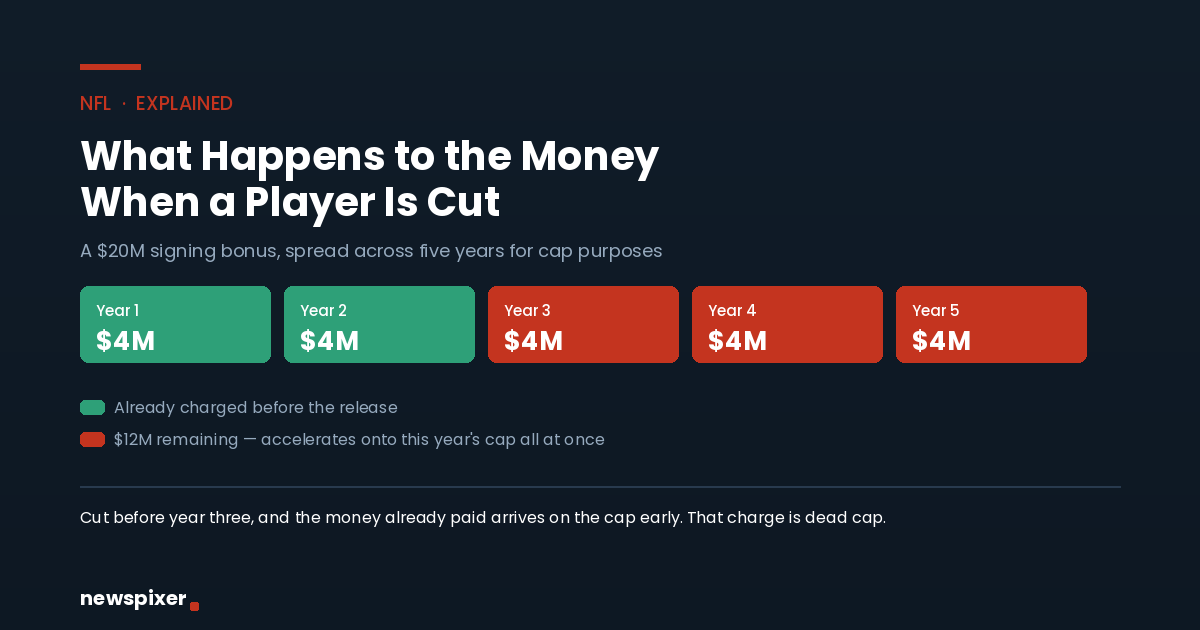
It exists because of how signing bonuses are accounted for. A bonus is paid up front but spread across the contract for cap purposes, up to a maximum of five years.
Take a $20 million signing bonus on a five-year deal. For cap purposes that’s $4 million a year. If the player is released before year three, the remaining $12 million doesn’t vanish — it accelerates onto the current year’s cap all at once.
The money was already spent. The cap charge just arrives sooner than planned.
Guaranteed salary works similarly: on release, it accelerates and lands as dead cap in the current season. On a trade, unpaid guarantees transfer to the new team instead.
Cutting a player can cost more than keeping him
This is the part that surprises people, and there was a clear example in 2026.
Atlanta’s Kirk Cousins carried a $24.6 million cap hit — $2.1 million in base salary, $12.5 million in prorated signing bonus, and $10 million in roster bonus. Cutting him before June 1 would have accelerated the remaining bonus money and pushed his dead cap charge to around $35 million.
In other words: releasing him would have consumed more cap space than keeping him on the roster.
Situations that extreme are rare. But they explain why teams sometimes hold onto players who clearly aren’t in their plans — the cap arithmetic makes leaving them alone the cheaper option.
Why June 1 matters so much
The NFL calendar has a hard line at June 1, and it exists specifically to soften this problem.
Released before June 1: all remaining prorated bonus money accelerates onto the current year’s cap immediately.
Released after June 1: only the current year’s proration counts now. Everything remaining moves to next year’s cap instead — splitting the charge across two seasons rather than absorbing it in one.
That’s a meaningful difference. But waiting until June has an obvious drawback: free agency opens in March, and a player released in June arrives after the market has largely been picked over.
The post-June 1 designation
The 2006 collective bargaining agreement created a way around that conflict, and it’s been in every agreement since.
Each team may designate up to two players per year as post-June 1 releases. The player is released immediately — free to sign elsewhere in March — while the team gets the split-across-two-years cap treatment.
The catch: the team must carry the player’s full cap number until June 2, even though he’s already gone. The savings don’t arrive until then.
Eleven players were released with post-June 1 designations during the 2026 league year. Four teams — Cleveland, Green Bay, Miami and Minnesota — used both of their allocations.
One limitation worth knowing: post-June 1 designations apply only to releases, not to trades.
Is dead money actually “wasted”?
Mostly it’s a sunk cost rather than a new expense. The money was typically paid long ago as a signing bonus. The dead cap charge is an accounting consequence, not a fresh cheque.
A payment is genuinely attached only when there are outstanding salary guarantees, or when the player has already begun receiving compensation in the current league year.
That said, the cap consequences are real. Dead money occupies space that could have gone toward signing free agents or extending players a team wants to keep. Carrying a lot of it makes building a competitive roster measurably harder — which is why front offices treat it as one of the most important numbers they manage.
Leave a Reply