
Why Do the Lions and Cowboys Play on Thanksgiving?
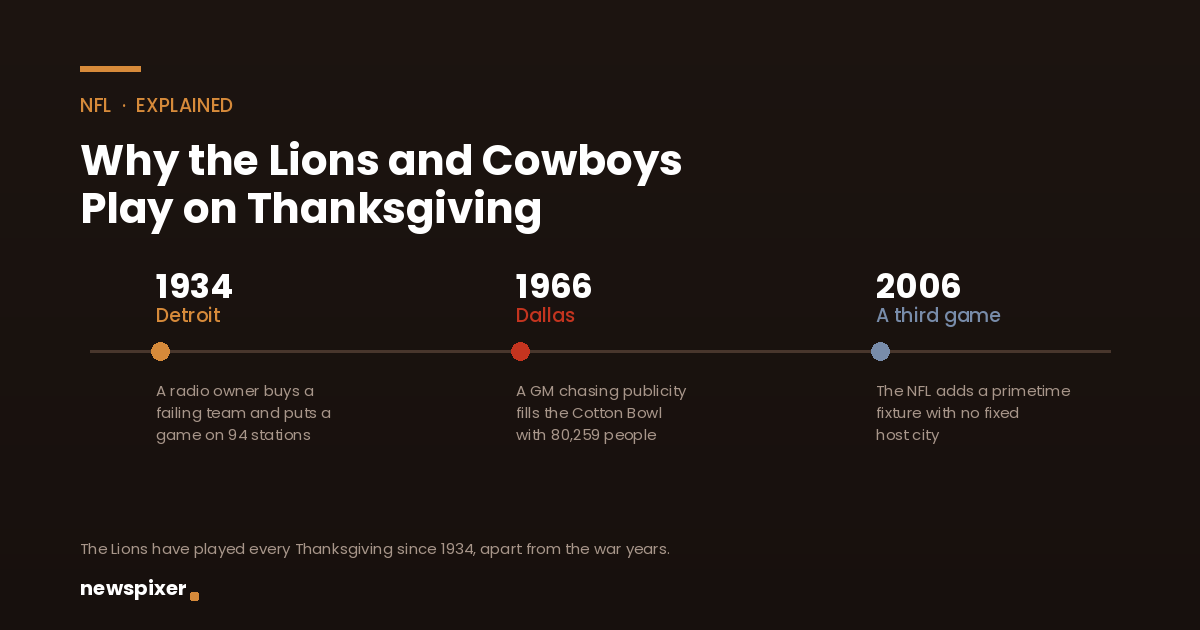
Two NFL teams host a game every Thanksgiving, and they’re the same two teams every year. It isn’t tradition for its own sake, and it wasn’t handed to them by the league. Both franchises took the slot because nobody else wanted it, and both did it for the same reason: publicity.
Detroit, 1934: a radio man’s marketing stunt
The Lions didn’t exist in Detroit before 1934. They were the Portsmouth Spartans, from a town in Ohio too small to sustain a professional team.
That year, a Detroit radio executive named George A. Richards bought the franchise and moved it north. He had a problem immediately: Detroit already had the Tigers, and the city wasn’t interested. The best crowd the Lions could draw in the early weeks of that season was around 15,000.
Richards owned WJR, one of the most powerful radio stations in the country, and he understood distribution better than football. His idea was to schedule a game on Thanksgiving — a day nobody was playing — and use his network connections to put it everywhere. He convinced NBC to carry the game across 94 stations nationwide.
It worked immediately. The opponent was the Chicago Bears, defending champions and undefeated. The Lions had one loss. The winner would take the NFL’s Western Division. All 26,000 tickets sold out two weeks in advance, and the Hall of Fame’s records suggest another 25,000 people would have come if there had been room. Fans were turned away at the gate.
The Bears won 19–16. Detroit got their revenge the following Thanksgiving, beating Chicago 14–2 in 1935.
The result mattered less than the audience. Detroit has played on Thanksgiving every year since, with one interruption: 1939 to 1944, when the games were paused during the Second World War.
Worth noting — the Lions didn’t invent football on Thanksgiving. Teams had played on the holiday before, including a Detroit Heralds game against the Canton Bulldogs in 1917. What Detroit had was the network deal. That’s what made it stick.
Dallas, 1966: a general manager chasing attention
Thirty-two years later, the Cowboys did the same thing for the same reason.
Tex Schramm was Dallas’s general manager, and this was before anyone called them America’s Team. He wanted national publicity, and a holiday game with no competition was the obvious route to it.
The NFL wasn’t convinced. League officials were sufficiently worried the game would flop that they guaranteed the Cowboys a minimum amount of gate revenue — an insurance policy against an empty stadium.
They needn’t have bothered. 80,259 people packed the Cotton Bowl, a new attendance record, and Dallas beat the Cleveland Browns 26–14.
What followed made the arrangement permanent. The Cowboys reached the playoffs in 18 of the next 20 seasons and won two Super Bowls in that span. A team that was nationally visible every Thanksgiving, and good, became the most widely followed franchise in the sport. The holiday game was part of how that happened.
Dallas have hosted every year since 1966, with two exceptions — 1975 and 1977, when the St. Louis Cardinals took the slot instead.
Why they’ve never given it up
The simple answer is that it works, for everyone involved.
For the two teams, it’s the largest guaranteed home audience of the year. For the NFL, it’s one of the highest-rated windows on the calendar. For the networks, it’s a captive audience on a day when tens of millions of people are at home with the television on.
There have been periods where it drew criticism — mostly during long stretches when Detroit were poor, and the argument surfaced that a team having a bad decade shouldn’t be handed a national showcase annually. That argument lost, partly because the tradition itself had become the draw rather than the quality of the football.
The Lions’ all-time Thanksgiving record is 37–45–2. They have lost more of these games than they’ve won and kept the slot regardless, which tells you the arrangement was never really about competitiveness.
The third game, and what changed in 2006
For decades there were two Thanksgiving games: Detroit at lunchtime, Dallas in the afternoon.
In 2006 the NFL added a third game in the primetime evening window, with no fixed host. Any two teams can be scheduled into it, which is how a Thanksgiving fixture now reaches cities that have never had one.
That addition quietly settled the old debate. With a third game available, the league no longer had to choose between honouring the tradition and giving other markets a holiday fixture. It could do both.
One thing that has never happened
In more than ninety years of Thanksgiving football, the Lions and the Cowboys have never played each other on the day.
Both are hosts, so a meeting would require one of them to give up their home game. Neither has.
Thanksgiving 2026
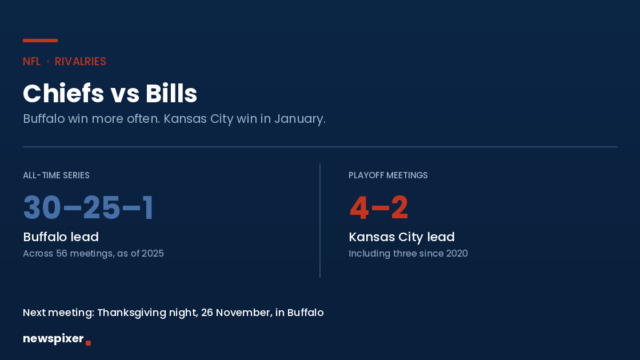
The tradition holds. Detroit and Dallas host their usual fixtures, and the evening game continues to travel — this year to Buffalo, where the Bills host Kansas City in the first Thanksgiving game ever played there.
Ninety-two years after a radio executive tried to fill a stadium, the format he invented is still the busiest day in American football.
Leave a Reply