
Thousands Protest in Madrid Over Spain’s Housing Crisis

| Event | Mass demonstration in central Madrid against rising rents and housing shortages |
|---|---|
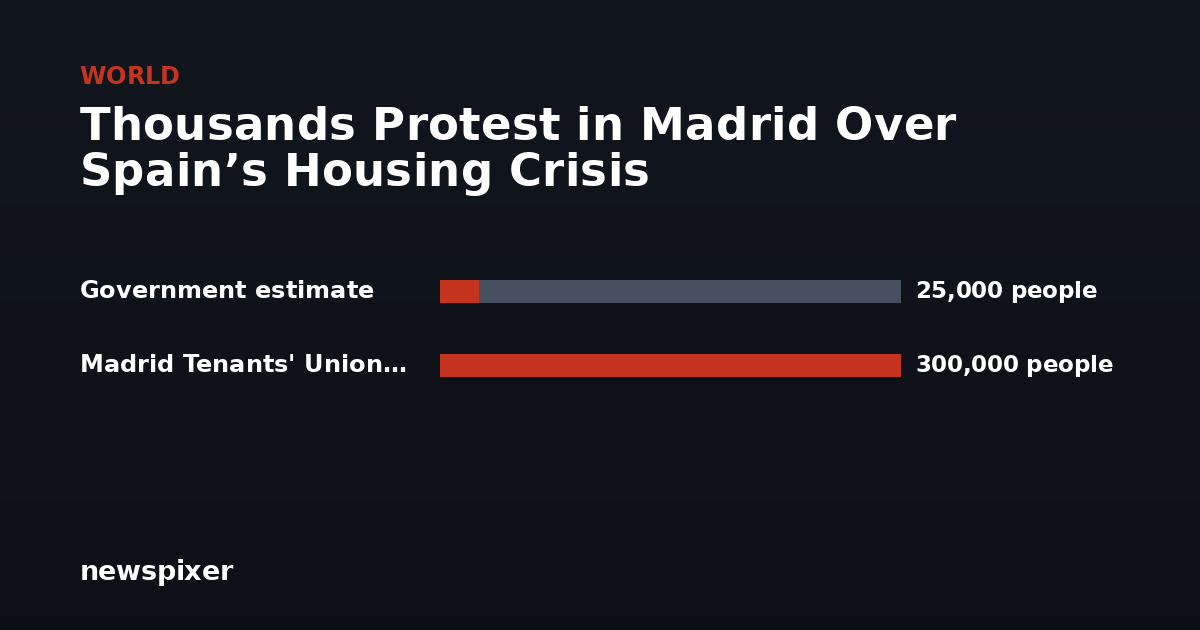
| Attendance | 25,000 according to government authorities; over 300,000 according to organizers |
| Catalyst | Eviction of an 87-year-old woman from her long-term apartment in Madrid |
| Housing Deficit | Bank of Spain estimated a nationwide shortage of 550,000 homes last year |
Demonstrators marched through central Madrid on Saturday to demand urgent government action against escalating rents and urban housing shortages across Spain. The rally was triggered by the recent eviction of an 87-year-old resident from her long-time apartment, bringing public anger over real estate speculation and tenant vulnerability to a head.
Mass Demonstration and Encampment
Organized by the Madrid Tenants’ Union, the weekend demonstration drew large crowds to the Spanish capital. Turnout figures varied widely depending on the source: government authorities estimated attendance at approximately 25,000 people, whereas protest organizers reported that more than 300,000 participants took part.
Following the conclusion of the march, a group of activists established an encampment in Puerta del Sol, a major central square. Protesters pitched tents overnight, declaring their intention to occupy the site until forcibly cleared by law enforcement, while police maintained a presence nearby.
Demonstrators called for enhanced legal protections for renters, strict regulations against fraudulent practices, and an immediate prohibition on evictions when no alternative residence is available. “Housing is a right, and we don’t have it,” said Dora Garcia, a 55-year-old nurse attending the rally. Simón de la Riva, a 43-year-old teacher, criticized real estate speculation, saying that “vulture funds are buying up homes” at the expense of local families.
The Eviction That Sparked Mobilization
Public outrage intensified following the eviction on Wednesday of 87-year-old Maricarmen Abascal from her apartment in Madrid’s Retiro neighborhood. Abascal had resided in the flat since 1956, when her father first signed a rent-controlled lease. She remained in the home following her parents’ deaths.
The property was purchased in 2018 by Urbagestion, an investment fund, which subsequently raised the monthly rent from €500 to €2,650. Abascal was offered an option to buy the apartment but could not afford the price. Although the fund later reduced the proposed monthly rent to €1,650, she remained unable to pay. Spanish courts suspended the eviction order three times before it was executed on Wednesday, when Abascal was carried out on a stretcher into an ambulance surrounded by supporters.
Rising Rents and Housing Deficit
The controversy surrounding Abascal’s removal has heightened scrutiny of urban real estate pressures across Spain. Analysts point out that rising rental rates in major cities are driven by a combination of gentrification, expanded tourism, and population growth fueled by immigration, all of which have strained the available residential supply.
Background
Housing policy has become a central political topic in Spain ahead of national elections scheduled for next year. Figures released by the Bank of Spain highlighted the structural scale of the problem, projecting a deficit of roughly 550,000 residential units across the nation last year.


Leave a Reply