
US bans Canadian alcohol and dairy in trade dispute

| Ban effective date | September 29, 2026 |
|---|---|
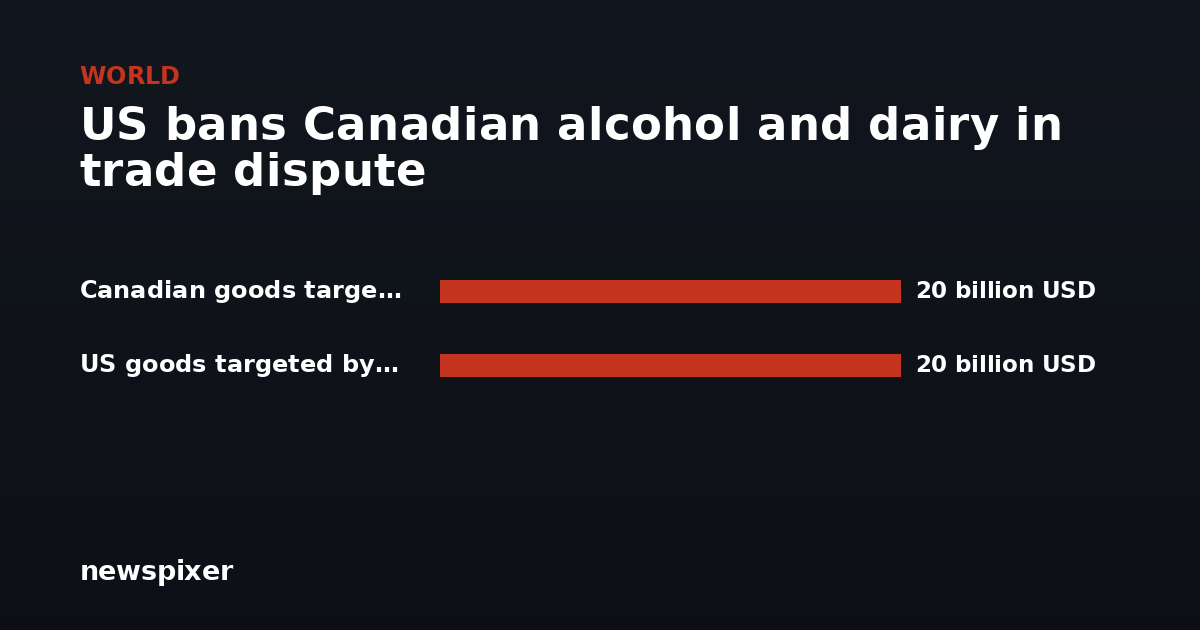
| US goods hit by Canadian tariffs | $20 billion |
| Canadian goods hit by US tariffs | $20 billion |
| Canadian counter-tariff range | 15% to 50% |
| Canada export share to US | Nearly 68% |
The United States has announced import bans on Canadian alcohol, motorcycles, and dairy products, escalating a trade conflict between the two neighbouring nations. The measures, published on the White House website, are scheduled to take effect on September 29, 2026.
The announcement follows Canada’s implementation of retaliatory tariffs on American imports after midnight on Tuesday. Both actions come after multiple rounds of bilateral trade negotiations collapsed without an agreement.
New import bans and expanded tariffs
The impending American bans cover a wide range of Canadian products. The restrictions on alcohol encompass beer, wine, whisky, bourbon, rum, vodka, vermouth, tequila, mezcal, and brandy. White House notices indicate that dairy-related restrictions extend to whey protein, non-alcoholic beer, invert molasses, and cane molasses. Shipments of motorcycles are also prohibited.
Alongside the total bans, Washington expanded its list of Canadian goods subject to a 50 percent tariff. Newly targeted items include several cheese products, paper, aluminium, wood, furniture, and lighting equipment.
These actions follow 50 percent tariffs introduced by the US last month on approximately $20 billion of Canadian exports, representing roughly 5 percent of Canada’s total sales to the US. Those earlier duties hit sectors including dairy, furniture, cement, apparel, fishing rods, and hockey gear.
Canadian retaliation and economic strategy
Ottawa’s retaliatory duties went into effect early Tuesday in response to last month’s US tariffs. Covering around $20 billion in American products, the Canadian tariffs range from 15 percent to 50 percent on goods such as steel, furniture, clothing, and electronics.
Canadian officials designed the counter-measures to apply targeted political and economic pressure on key US industrial regions, including competitive states such as Michigan and Ohio, ahead of the US midterm elections in November.
In a video message, Canadian Prime Minister Mark Carney urged the country to diversify its trade relations beyond the US. “We have everything we need to pivot and prosper,” Carney said, noting that “That pivot will come at a cost.” Michael Harvey, executive director of the Canadian Agri-Food Trade Alliance, expressed concern over the dispute, saying, “What we are worried about is an escalatory spiral.”
Ongoing negotiations and political pressure
Despite the escalation, communication between trade negotiators continues. US Trade Representative Jamieson Greer and Dominic LeBlanc, the Canadian minister overseeing bilateral trade, have held talks recently and are slated to speak again to seek a resolution.
In a social media statement, LeBlanc criticized the latest US restrictions, writing that Ottawa’s primary objective remains protecting Canadian workers and businesses from unjustified trade measures. Meanwhile, a US official noted that President Donald Trump’s threat to raise tariffs on Canadian automotive imports from 25 percent to 50 percent on January 1 remains active.
Trump has also signaled further actions, warning that Canadian jet manufacturer Bombardier could be barred from selling private aircraft in the US unless it establishes domestic manufacturing. Additionally, Trump instructed the General Services Administration to remove Canadian products from federal procurement schedules unless Canada grants full reciprocity to American businesses.
Background
The worsening standoff threatens to destabilize the United States-Mexico-Canada Agreement (USMCA), the trade framework that replaced NAFTA to govern commerce across North America. The dispute carries significant stakes for Canada, which sent nearly 68 percent of its total exports to the United States this year, with roughly 80 percent of those goods historically entering duty-free.


Leave a Reply