
China Exports Rise 25% in August as Trade Surplus Widens

| August export growth | 25% year-on-year |
|---|---|
| August import growth | 28.2% year-on-year |
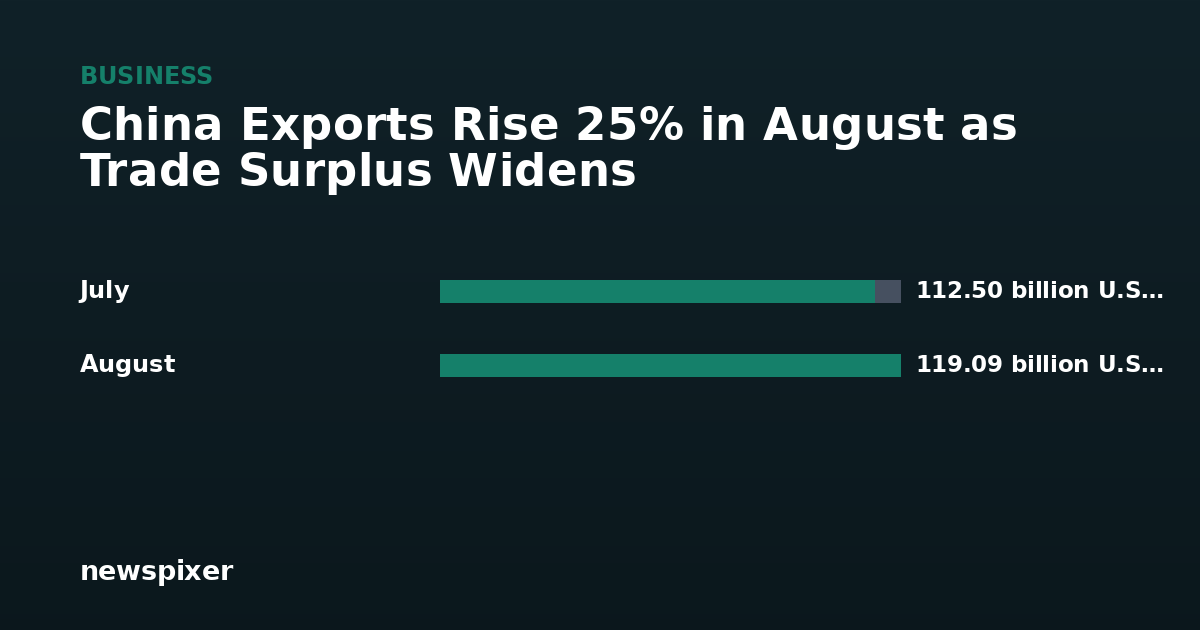
| August trade surplus | $119.09 billion |
| Offshore yuan exchange rate | 6.7099 per U.S. dollar |
China’s export growth accelerated in August while import growth fell short of economic forecasts, highlighting a persistent disparity between strong overseas demand and weak domestic consumption. Official customs figures published on Tuesday showed exports expanded 25% in U.S. dollar terms from a year earlier, expanding China’s trade surplus to $119.09 billion. The widening imbalance comes amid growing international pushback over Beijing’s reliance on manufacturing exports to shore up national growth.
Export Performance and Trade Bilaterals
The 25% year-on-year surge in August exports accelerated from a 23.9% gain recorded in July, aligning with forecasts from analysts polled by Reuters. Global demand for high-tech components tied to artificial intelligence infrastructure continued to propel Chinese shipments, helping offset domestic investment declines and geopolitical tensions. In contrast, imports grew 28.2% in August, picking up from 27.5% in July but missing the 30% expansion expected by economists. Consequently, the monthly trade surplus rose from $112.5 billion in July.
Trade flows varied significantly across major commercial partners. Chinese shipments to the United States grew 34.4% in August, maintaining a streak of double-digit monthly gains observed throughout much of the year, while Chinese purchases of U.S. goods rose 17.8%. Exports to the European Union expanded by 6.6%, whereas imports from the bloc increased by 0.7%. Trade with South Korea saw a major surge, with Chinese imports more than doubling and exports rising nearly 50% year-on-year.
International Friction and Currency Pressure
China’s reliance on foreign sales has intensified political pressure from foreign trade partners demanding economic rebalancing. Zhiwei Zhang, chief economist at Pinpoint Asset Management, stated that “China continues to rely on exporters to support the economy” while domestic demand stays subdued. Earlier this month, finance ministers from the Group of 20 issued a joint statement criticizing nations heavily dependent on export-led growth, with China standing as the sole dissenting member. Beijing rejected the criticisms, describing trade complaints as “an excuse to pressure and restrict China.”
Speaking at the G20 meeting, People’s Bank of China Governor Pan Gongsheng stated that China has never actively pursued a trade surplus or devalued its currency to gain market competitiveness, adding that domestic markets remain open to foreign commercial enterprises. The offshore yuan traded at 6.7099 per U.S. dollar following the release of the trade statistics, reflecting a 3.8% appreciation against the dollar since the start of the year. Despite this gain, foreign policy analysts argue the currency remains low, with Council on Foreign Relations senior fellow Brad Setser estimating the yuan is undervalued by 20%. The trade friction precedes a scheduled visit by Chinese leader Xi Jinping to Washington D.C. later this month.
Domestic Slowdown and Policy Interventions
The strength of China’s export sector contrasts with sluggishness in the broader domestic economy. Gross domestic product growth decelerated to 4.3% in the second quarter—a low not seen in over three years—putting Beijing’s full-year growth target of 4.5% to 5% at risk. Economic activity indicators for July pointed to weakening investment and domestic orders, alongside a second consecutive month of contraction in manufacturing output.
In response, fiscal authorities have accelerated government spending to stabilize domestic markets. Beijing plans to execute a $54 billion capital injection into state-owned banks and insurance institutions to boost financial stability. Evercore ISI strategist Neo Wang noted that recent policy communications demonstrate a determination to arrest the investment decline. Market analysts also anticipate potential monetary policy moves, with Hutong Research partner Shan Guo predicting one or two interest rate cuts by the end of the year depending on global central bank policies and the appreciation pace of the yuan.
Background
China has long faced pressure from major trading partners over its substantial trade surplus and currency valuation. Western governments argue that heavy state support for manufacturing combined with low domestic consumption creates structural distortions in global commerce. Beijing maintains that its trade position reflects natural market competitiveness and international demand for its manufactured products.


Leave a Reply