
Scientists Detect Unexplained Particle Interaction in Underground Dark Matter Search

| Experiment | LUX-ZEPLIN (LZ) dark matter experiment |
|---|---|
| Location | Sanford Underground Research Facility, South Dakota, United States |
| Key Finding | Single unexplained particle signal recorded on June 16, 2023 |
| Team Size | 250 scientists and engineers across 38 institutions |
Scientists operating an underground research facility in the United States have detected an unexplained particle interaction that matches theoretical predictions for dark matter, though researchers emphasize the finding does not constitute a confirmed discovery.
The signal was recorded at the Sanford Underground Research Facility, located inside a former gold mine in Lead, South Dakota. An international team of 250 scientists and engineers from 38 institutions analyzed 220 days of data recorded between March 2023 and April 2024 by the LUX-ZEPLIN (LZ) experiment, identifying a single anomalous event from June 16, 2023.
How the Detector Operates
The LZ experiment uses a large underground tank filled with ultra-pure liquid xenon surrounded by hundreds of light sensors. Researchers designed the instrument to test whether hypothetical dark matter particles called weakly interacting massive particles, or WIMPs, interact with xenon nuclei. A collision between a WIMP and a xenon nucleus is predicted to emit two flashes of light at a distinct energy level.
Physicists involved in the project described the isolated event as the most compelling signal produced by LZ so far, representing a potential signpost for a particle beyond current physical models.
Researcher Evaluation and Verification
Sam Eriksen, a senior research associate at the University of Bristol and lead researcher on the study, presented the findings at the 2026 TeV Particle Astrophysics conference in Japan. Eriksen noted in a press statement “that even a single outstanding event, like the one we found, is important” because of the team’s detailed understanding of the detector and background noise.
Other team members advised caution against drawing definitive conclusions. Rick Gaitskell, LZ spokesperson and physicist at Brown University, stated that researchers do not want to get ahead of themselves. Theresa Fruth, a physicist at the University of Sydney who worked on the study, told ABC News that the signal had survived repeated testing, stating that “This event just won’t go away even after many, many checks.”
Broader Cosmic Exploration
The findings coincide with expanding research efforts into unobservable cosmic phenomena. NASA recently announced plans to launch the $4 billion Nancy Grace Roman Space Telescope, an orbital observatory dedicated to investigating both dark matter and dark energy.
Background
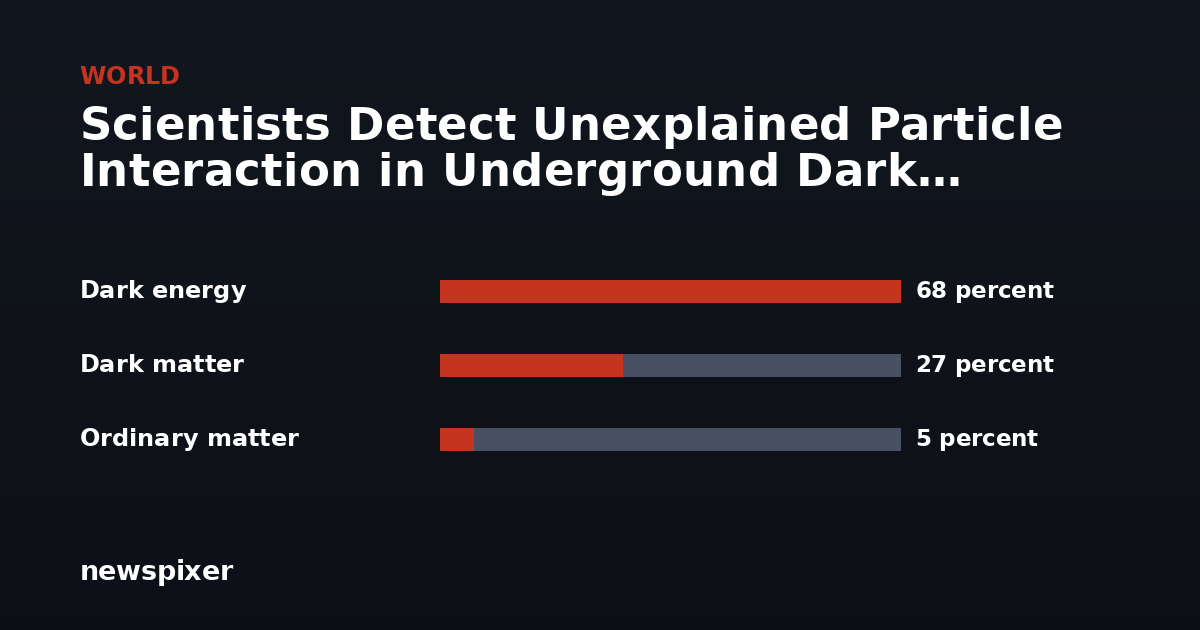
Dark matter accounts for approximately 27 percent of all matter in the universe, while dark energy makes up an estimated 68 percent. Ordinary matter—the physical substance comprising visible structures, planets, and living organisms—makes up only 5 percent of the cosmos. Dark matter cannot be detected directly by optical or electromagnetic sensors because it does not absorb, reflect, or emit light.
Evidence for invisible matter was first observed in the 1930s by Swiss astronomer Fritz Zwicky, who noticed that galaxies in the Coma Cluster moved at speeds too rapid for their visible mass to hold them together gravitationally. Subsequent astronomical measurements have confirmed the existence of unseen mass through its gravitational effects on rotating galaxies and the bending of light around massive galaxy clusters.



Leave a Reply