
Modi and Xi to Meet at BRICS as India-China Ties Thaw

| Event | Bilateral meeting at the BRICS Summit in India |
|---|---|
| Participants | Indian Prime Minister Narendra Modi and Chinese President Xi Jinping |
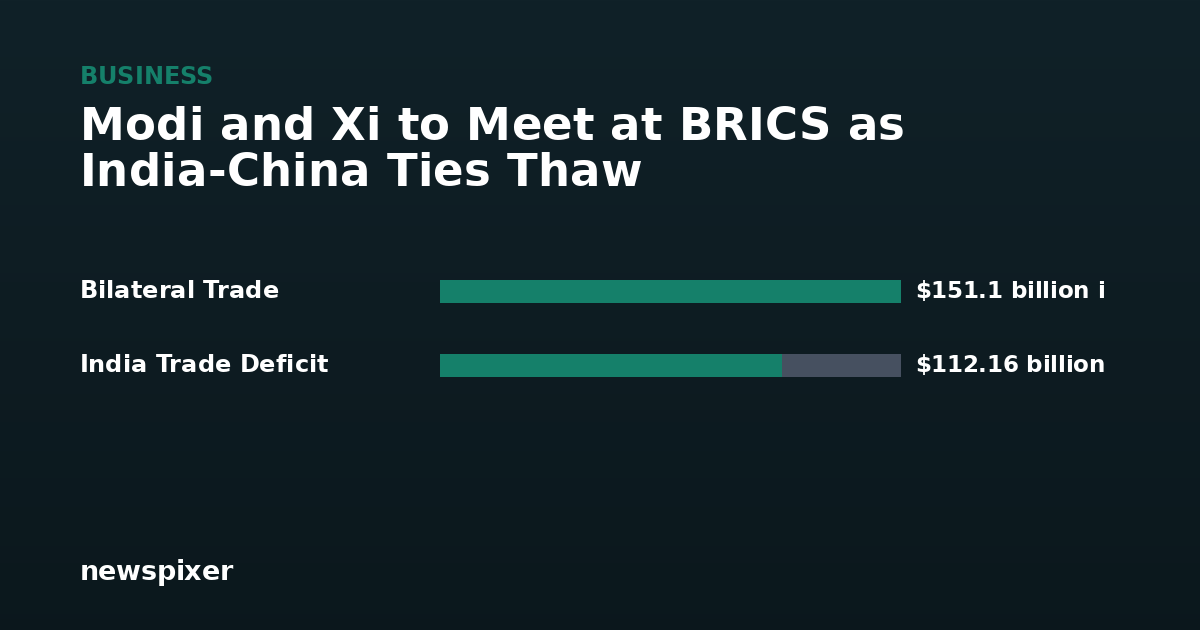
| Bilateral Trade | $151.1 billion in the year ending March 2026 |
| India Trade Deficit | $112.16 billion with China |
Chinese President Xi Jinping and Indian Prime Minister Narendra Modi are set to hold bilateral discussions at the BRICS summit in India, marking Xi’s first visit to the country since 2019. The upcoming meeting follows a period of gradual diplomatic thawing between the two Asian nations after deadly military clashes along their Himalayan border in 2020 severely strained relations.
The encounter between the leaders of the world’s two most populous nations comes as both countries seek to manage persistent border friction while navigating complex global economic and geopolitical pressures. According to media reports citing unnamed sources, Xi will be accompanied by a delegation of roughly 400 officials, more than double the size of his 2019 entourage.
Border Disputes and Recent Thaw
Relations between Beijing and New Delhi reached their lowest point in decades following the 2020 high-altitude border conflict, reviving tensions rooted in their 1962 border war. However, diplomatic contact has intensified over the past year. In August, Chinese Foreign Minister Wang Yi and Indian National Security Advisor Ajit Doval met to review cross-border exchanges, including Himalayan pilgrimage routes and border trade.
Despite recent steps to resume direct commercial flights and relax Indian restrictions on Chinese investments, underlying military mistrust remains. Reports from August indicated that Chinese forces had recently restricted Indian military access to key patrolling locations and encroached on territory in the northeastern Indian state of Arunachal Pradesh.
Vrinda Sahai, a research analyst at Carnegie India, described the summit as "a really crucial moment" for bilateral dialogue, though she noted that BRICS was originally established to reform global financial governance rather than resolve bilateral territorial conflicts.
Economic Strains and Trade Deficit
Trade imbalances form a central point of contention for India heading into the summit. China remains India’s largest trading partner, with total bilateral trade reaching a record $151.1 billion in the fiscal year ending March 2026. However, India’s trade deficit with China widened to a record $112.16 billion, up from $99.21 billion in the prior period.
New Delhi relies heavily on Chinese imports for critical sectors, including green energy infrastructure that depends on Chinese battery manufacturing. Conversely, India has implemented trade barriers on goods such as electrical steel and aluminium foil to protect domestic producers, while China has maintained strict controls on rare earth exports and technical equipment transfers.
These industrial restrictions previously affected Indian manufacturing operations, including iPhone production lines established as Apple expanded its supply chain into India. While India seeks greater market access in China to reduce its trade distortion, financial analysts expect foreign direct investment regulations between the two countries to ease cautiously.
Geopolitical Alignment and Multipolar Strategy
The bilateral thaw occurs alongside shifts in wider international relations. India’s diplomatic outreach to Beijing comes as New Delhi faces trade friction and elevated tariffs under the second administration of U.S. President Donald Trump, prompting India to strengthen ties across multiple global partners.
Prior to the BRICS gathering, Modi and Xi met alongside Russian President Vladimir Putin at the Shanghai Cooperation Organisation summit in Kyrgyzstan. The leaders signed the Bishkek Declaration, which condemned military strikes against Iran without directly naming the United States. Chietigj Bajpaee, a senior research fellow at Chatham House, noted that India’s recent diplomatic engagements confirm its "continuing commitment to strategic hedging" through various global partnerships.
Background
BRICS was originally founded by Brazil, Russia, India, China, and South Africa as a coalition focused on reforming global economic governance and financial institutions. The group has since expanded into an 11-member bloc that includes nations such as Iran. While the summit provides a venue for high-level bilateral diplomacy, the forum itself is designed for multilateral economic policy rather than resolving direct border or territorial disputes between member states.


Leave a Reply