
China Expands Tax Scrutiny on Offshore Assets

| Offshore trust income tax | 20% |
|---|---|
| 2025 net capital outflows | $780 billion |
| China tax-to-GDP ratio (2024) | 19.5% |
| OECD tax-to-GDP average | 34% |
Chinese authorities are intensifying efforts to collect tax revenue from the offshore holdings and overseas income of the country’s wealthiest citizens. The stepped-up enforcement comes as local governments face severe budget shortfalls and capital leaves China at record levels. Analysts say the recent regulatory actions mark the start of a broader, long-term effort to establish global tax collection oversight.
Recent Policy Enforcement
Beijing has introduced multiple regulatory measures targeting cross-border assets. Financial institutions in Hong Kong moved in May to restrict mainland investors from purchasing foreign equities following regulatory pressure to curb cross-border trading. In July, Chinese authorities implemented a 20% income tax on offshore trusts, closing a financial structure frequently used by affluent families to protect wealth and manage inheritances.
Regulators have also reportedly begun collecting taxes on overseas salaries and earnings from foreign insurance policies. In addition, tax authorities introduced a 20% levy on dividends that foreign investors receive from foreign-funded companies operating in China, a category that was previously exempt. A Hong Kong legal expert who was not identified due to the sensitivity of the subject noted that “the sudden moves signal some urgency.”
Economic Strains and Capital Outflows
The push to tap offshore wealth is driven by domestic fiscal pressure. Land sales, which historically provided essential revenue for municipal governments, have fallen sharply during an extended property downturn. Barclays estimates show that Chinese government revenue dropped to roughly 20% of gross domestic product in 2025, down from 26% in 2021. Over the same period, state spending declined only slightly from 31% to 29% of GDP.
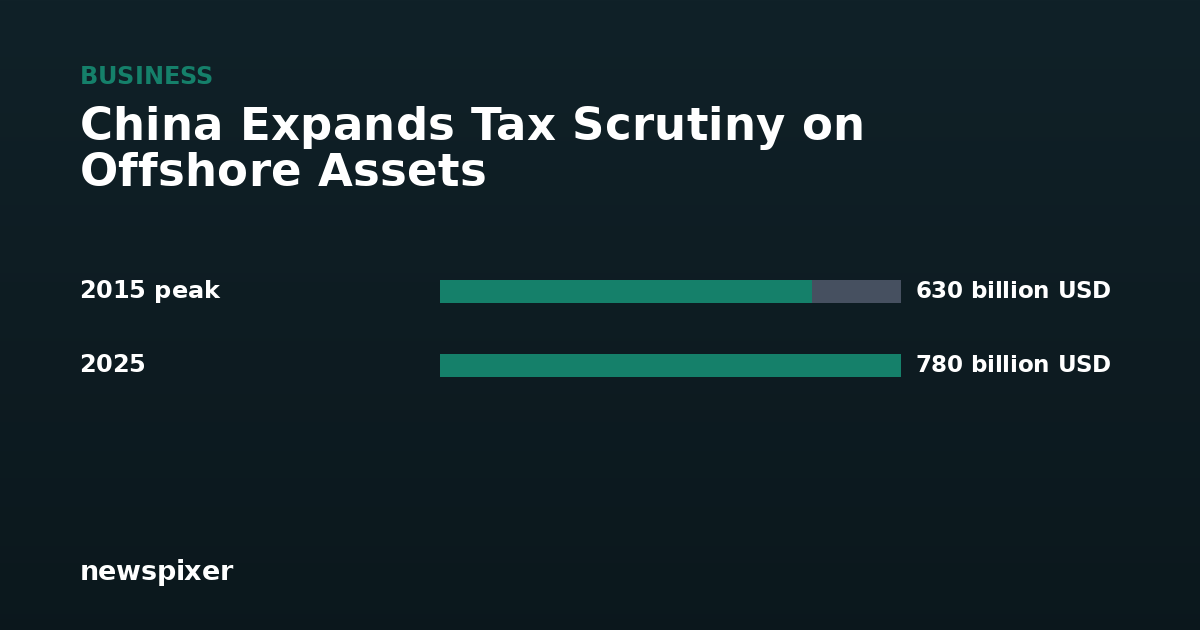
At the same time, capital flight has reached unprecedented levels. Net outflows from China hit nearly $780 billion in 2025, surpassing the previous peak of about $630 billion recorded in 2015. Data from KPMG indicates that more than half of China’s wealthiest individuals manage their holdings through offshore family trusts, holding hundreds of billions of dollars in foreign assets.
Potential Future Tax Measures
China collects less direct tax relative to its economy than most major nations. Bank of America Research figures show China’s tax-to-GDP ratio stood at 19.5% in 2024, compared to the Organisation for Economic Co-operation and Development average of 34%. Unlike many advanced economies, China does not currently impose real estate, gift, or inheritance taxes.
Financial analysts expect authorities to eventually expand taxation to foreign real estate profits, equities, fixed-income investments, precious metals, and exporter earnings held abroad. Legal experts suggest Beijing may ultimately transition from passive monitoring to a worldwide taxation regime similar to that of the United States, which could include exit taxes for citizens who choose to emigrate.
Background
China’s municipal governments rely heavily on land sales and central government transfers to fund local services and infrastructure. A downturn in the domestic property market has sharply reduced land revenues, forcing officials to search for new income streams. Simultaneously, Beijing is attempting to retain capital domestically to bolster state-supported technology industries and strengthen regional financial markets.


Leave a Reply