
Fantasy Football Sleepers 2026: 15 Late-Round Picks That Win Leagues
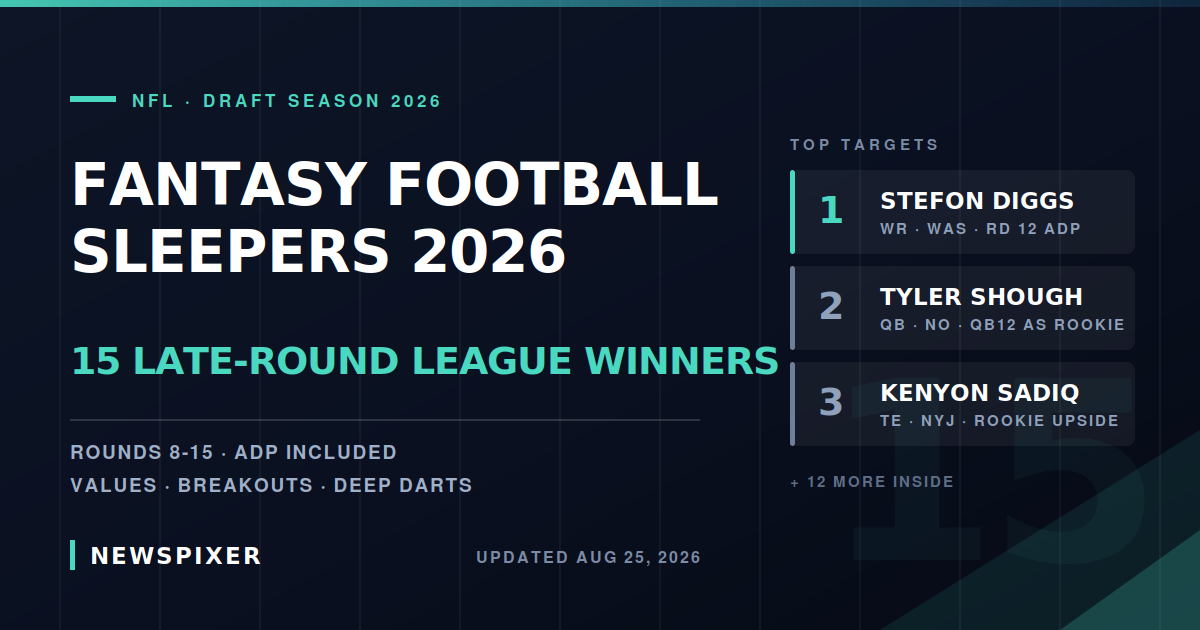
You cannot win a fantasy league in the first two rounds. You can absolutely lose one there.
Championships get built in Rounds 8 through 14 — the picks nobody screenshots, the names your league-mates have to look up. Hit on three of them and you have a starting lineup deeper than anyone else’s. Miss on all of them and you spend October trawling waivers while someone else runs away with the standings.
Here are Newspixer’s 15 best fantasy football sleepers for 2026, organised by where you should actually be drafting them. This is the companion piece to our 2026 busts list — that one is about what not to pay for, this one is about where the value went.
What Counts as a Sleeper
A sleeper is not “a player who will be good.” It is a player whose price is lower than his likely role.
Every name below is going outside the top 100 picks, or is being drafted meaningfully below where his projected usage suggests. Some you’ve heard of. Some you haven’t. All of them are cheap enough that being wrong costs you almost nothing — which is the entire point.
One rule before we start: a sleeper drafted two rounds early is not a sleeper. The value is in the price. If you reach for these names, you have manufactured your own bust.
Mid-Round Values (Rounds 6–10)
Stefon Diggs, WR, Washington Commanders
The single best value on the board right now, and it exists purely because of timing — Diggs did not sign with Washington until August 7, so his ADP has not caught up.
The production is not in decline. He caught 85 passes for 1,013 yards in New England last season and finished as the fantasy WR17. More persuasively, he led the entire league in catch rate over expected at 15.4% among players with 50-plus targets, hauling in 83.3% of everything thrown his way. His 2.4 yards per route run ranked fifth among all players with 300-plus routes — behind only Puka Nacua, Jaxon Smith-Njigba, Zay Flowers and Amon-Ra St. Brown.
He is 32, and that matters. But he slots in as the clear 1B to Terry McLaurin’s 1A in a Jayden Daniels offense, and he is currently going in the 12th round. That gap will close before September. Draft him now.
Jaylen Warren and Rico Dowdle, RB, Pittsburgh Steelers
The best ambiguous backfield on the board. Both are available around the seventh round, and both project to handle genuinely valuable touches rather than just carries.
The beauty of a true committee at that price is that you do not need to guess correctly. Take whichever falls to you. If one separates in September, you have an RB2 for the price of a bench stash.
DeVonta Smith, WR, Philadelphia Eagles
With A.J. Brown traded to New England, Smith becomes Philadelphia’s unquestioned No. 1 for the first time in his career — and gets to line up where he is best. He posted an 89.9 PFF receiving grade out wide in 2025 with a 25.3% target rate in those alignments.
The one caveat is significant and we have written about it before: Philadelphia has one of the hardest fantasy playoff schedules in football — Seattle, Houston and at San Francisco in Weeks 15-17. Smith is a value on talent and role; just know what December looks like.
Jared Goff, QB, Detroit Lions
Not a sleeper so much as a persistent market inefficiency. Goff has finished as a QB1 for four consecutive seasons and gets drafted outside that range every single year.
The path is straightforward: an immobile quarterback needs volume and touchdown efficiency, and roughly 4,500 yards with 32 touchdowns gets it done. Detroit also draws one of the softest schedules in football by projected win totals, including cross-division matchups with the NFC South and the AFC East. His lack of rushing production is the only thing holding him down, and it is fully priced in.
Josh Downs, WR, Indianapolis Colts
A high-floor slot receiver in an offense that should throw more than the market expects. Downs is the kind of player who quietly finishes WR30 while costing a WR50 price.
Late-Round Sleepers (Rounds 11–14)
Cam Ward, QB, Tennessee Titans
The rookie numbers were rough, which is exactly why he is cheap. The Year 2 case is stronger than his ADP suggests.
Tennessee hired Brian Daboll as offensive coordinator — the coach who developed Josh Allen in Buffalo. They drafted Carnell Tate fourth overall and signed Wan’Dale Robinson. Ward flashed real arm talent throughout his rookie season and closed it by throwing two touchdowns in each of his final four full games. Quarterbacks historically make their largest leap between Years 1 and 2.
None of that guarantees anything. At a 13th-round price, it does not have to.
Tyler Shough, QB, New Orleans Saints
Nine starts as a rookie, and over those nine games he finished 12th among all quarterbacks in fantasy points per game — with sneaky rushing production on top of efficient passing. That is a QB1 rate in a tiny sample, available at the very end of drafts. New Orleans also has one of the three easiest fantasy playoff schedules.
Parker Washington, WR, Jacksonville Jaguars
Washington finished 2025 as a top-10 receiver by PFF receiving grade at 85.1, and closed strong: 26 catches for 454 yards and three touchdowns across his final four games including the playoffs. Jacksonville’s receiver room is unsettled enough that a genuine role is available.
Isaiah Likely, TE, New York Giants
ADP around 114. Likely spent years buried behind Mark Andrews in Baltimore, flashing whenever given snaps. In New York he gets a clear path to volume, and tight end is a position where volume alone produces startable weeks.
Chris Rodriguez Jr., RB, Jacksonville Jaguars
With Travis Etienne gone to New Orleans, the fantasy community crowned Bhayshul Tuten the successor and stopped looking. Rodriguez is the forgotten half of that backfield, and forgotten halves of backfields are how you find free RB2 production in October.
Kyle Monangai, RB, Chicago Bears
ADP around 107. Chicago’s backfield behind D’Andre Swift is not settled, and the Bears’ offense — with Caleb Williams, Rome Odunze, Luther Burden III and Colston Loveland — has enough scoring equity to make the No. 2 back matter.
Deep Sleepers (Round 15 and Beyond)
These are your final picks and waiver-day stashes. Most will not hit. One might win you a title.
Kenyon Sadiq, TE, New York Jets
The best deep dart on the board. He is a rookie tight end, on a middling team, in a low-scoring offense, without an elite quarterback — which is a description that applied word for word to Brock Bowers two years ago.
Premier rookie tight ends translate to fantasy far faster than they used to, and Sadiq projects into a hybrid receiver/tight-end role rather than a blocking one. At his cost, the upside is asymmetric.
Ja’Kobi Lane, WR, Baltimore Ravens
ADP around 184. Baltimore has been hunting for a genuine No. 2 opposite Zay Flowers for years, and Rashod Bateman’s flashes have never become consistent. Lane, a third-round rookie at 6-foot-4 and 200 pounds, shone in the preseason and wins contested catches — which makes him a plausible red-zone weapon for Lamar Jackson. Touchdown equity at a free price.
Oronde Gadsden II, TE, Los Angeles Chargers
His ADP does not reflect what his role could become in Mike McDaniel’s offense. One of the better late-round tight end swings if you punted the position.
Caleb Douglas, WR, Miami Dolphins
ADP around 225. Miami’s third-round rookie appears to have locked down a role with the first-team offense to open the season. That is a lot of opportunity for a pick nobody else in your league will spend.
Emmett Johnson, RB, Kansas City Chiefs
ADP around 189. He is the handcuff to Kenneth Walker III, who just signed a three-year deal to be Andy Reid’s closest thing to a workhorse in a decade. Handcuffs to genuine bell cows are the most valuable free picks in fantasy.
Also worth a final-round dart: Jonah Coleman (DEN, ~151), Tank Bigsby (PHI, ~155), Kaytron Allen (WAS, ~210), De’Zhaun Stribling (SF), Jalen Coker (CAR), Malik Washington (MIA), KC Concepcion (CLE).
The Preseason Hype Trap
A caution, because sleeper season produces more bad picks than good ones.
Several names above earned attention through preseason performance. Preseason production is a weak predictor — it comes against backup defenses, in vanilla schemes, with no game-planning. A receiver who catches seven passes in the third quarter of Week 2 has told you very little.
What actually matters is role, not production. Caleb Douglas working with Miami’s first-team offense is meaningful. Ja’Kobi Lane catching contested balls against third-string corners is suggestive at best. Weight the depth-chart news heavily and the box scores lightly.
The same discipline applies to injury-driven opportunity. Deebo Samuel’s value rose in San Francisco because Ricky Pearsall was ruled out for the season — that is a real, permanent change in target competition. A player who looked good while a starter sat out one practice is not the same thing.
How to Actually Draft Sleepers
Take them at cost, not before. The value is entirely in the price. Reaching two rounds early for Cam Ward converts a free lottery ticket into a bad pick.
Build a floor first. Sleepers are the top of your roster’s range, not its base. Secure reliable starters through Round 7, then swing.
Prioritise role over talent in the late rounds. A mediocre player with a defined job beats a talented one in a committee. This is why Chris Rodriguez and Emmett Johnson belong on this list.
Handcuff genuine workhorses, not committees. Backing up a bell cow is valuable. Backing up a timeshare gets you a third of a timeshare.
Do not draft five quarterbacks and four tight ends. One late quarterback swing and one late tight end swing is plenty. Spend the rest of your bench on running backs and receivers, where injuries create the most opportunity.
Cut them fast. A sleeper who is not playing a role by Week 3 is roster clutter. The waiver wire in September is where most league-winning pickups actually happen.
FAQ
Who is the best fantasy football sleeper in 2026? Stefon Diggs. He signed with Washington on August 7, his ADP has not adjusted, and he was the WR17 last season while leading the league in catch rate over expected.
What round should I start drafting sleepers? Round 8 or later. Rounds 1–7 should be spent on players with defined, projectable roles.
Which late-round quarterback should I target? Tyler Shough or Cam Ward. Shough finished 12th in fantasy points per game across his nine rookie starts; Ward gets Brian Daboll as coordinator and two new receivers.
Are rookie tight ends worth drafting late? Increasingly, yes. Kenyon Sadiq is the swing this year — a hybrid receiver/tight-end role at a near-free price.
How many sleepers should I draft? Four to six across the back half of your draft, spread across positions. Expect one or two to hit.
Should I trust preseason performances? Trust depth-chart movement. Distrust box scores. A confirmed first-team role means far more than a big statistical night against backups.
Sleeper values move fast in the final two weeks of August. We update this list as ADP shifts — check back before your draft.

Leave a Reply